Topical Authority: How to Build Topic Clusters That Outrank Bigger Sites
Publishing random articles for random keywords spreads your effort thin. Topic clusters concentrate it, so search engines see you as an authority. Here is how to build one.

Ranksul Team
SEO & Link Building Team
Why random keywords stop working
Many sites publish an article for every keyword they find, with no connection between them. Each article competes alone, internal links are random, and search engines see a site that touches many topics without owning any. Topic clusters fix this by covering one subject in depth and connecting every page.
The hub-and-spoke model
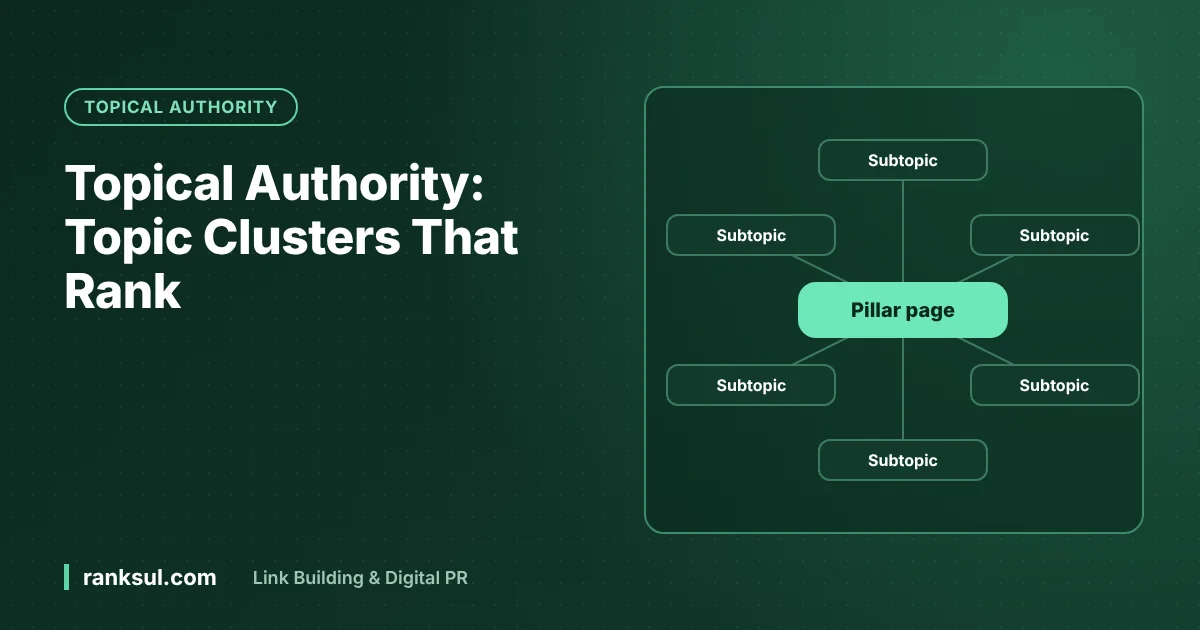
The hub, or pillar page, covers a broad topic such as "link building" and targets its main keyword. Spokes are supporting articles that answer specific questions: how to choose DA and DR metrics, guest posting vs outreach, anchor text planning. Each spoke links to the hub and to related spokes, and the hub links out to every spoke.
On this site, our editorial link building page is a hub, supported by articles such as the modern link building blueprint, manual outreach vs PBNs and choosing DA and DR metrics.
How to build a cluster
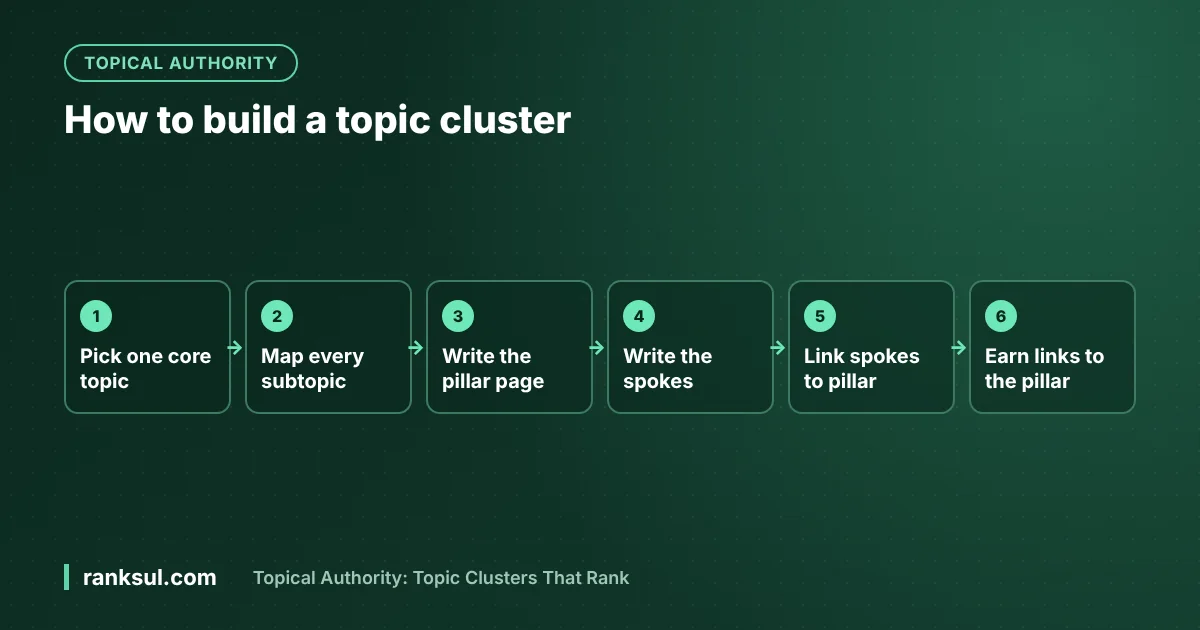
- Choose a core topic that matches a service or product you sell
- List the questions people ask, using Google Search Console, Ahrefs or Semrush and "People also ask" results
- Group questions by intent; each group becomes one spoke article
- Write the pillar page to cover the topic broadly and link to every spoke
- Link each spoke back to the pillar with a descriptive anchor, and to two or three related spokes
- Add a clear next step from the pillar to the service page
Write spokes that deserve to rank
Each spoke should be the best answer to its question: direct, specific and based on real experience. Follow Google's guidance on helpful, people-first content. Avoid near-duplicate spokes; if two articles answer the same question, merge them.
Our content strategy service maps clusters, and our SEO content writing team writes the pillar and spokes.
Internal links are the architecture
Internal links tell search engines which pages belong together and which matters most. Use descriptive anchors rather than "click here", link from the body text where it helps the reader, and make sure no spoke is an orphan. A crawler such as Screaming Frog shows pages with few internal links.
Strengthen the hub with external links
Links from other websites to your pillar page lift the whole cluster, because internal links pass that strength to the spokes. Point your best editorial placements and guest posts at hub pages, and use the Ranksul marketplace to find publications that cover the same topic.
What topical authority is (and is not)
Topical authority is an SEO term, not a published Google metric. It describes a pattern Google has confirmed in general terms: its systems try to identify sites with expertise on a subject, and sites that cover a topic thoroughly, with useful pages that link to each other and earn links from others in the field, tend to rank across many related queries.
It is different from domain authority: a small, focused site can outrank a large general site on its specialist topic.
How to map a topic cluster
- Pick a topic tied to what you sell, broad enough for 10–30 pages
- Collect every question people ask: search suggestions, "People also ask", forums, sales calls
- Group questions by intent: one page per distinct intent, not per keyword variant
- Choose the pillar: the broad guide or service page that links to every spoke
- List existing pages first; update or merge before writing new ones
- Order the spokes by business value and how winnable they are
Example: a link building cluster
Ranksul's own blog is organised this way. The pillar is the link building service, supported by spokes on link building strategy, cost, DR vs DA, guest posting safety, PBNs vs outreach and choosing an agency. Each spoke links to the pillar and to related spokes, and the price index acts as a data asset that earns links for the whole cluster.
Internal linking rules for clusters
- Every spoke links to the pillar with a descriptive anchor
- The pillar links to every spoke
- Spokes link to each other where the reader would naturally want to go next
- Use descriptive anchors, varied but clear, not "click here"
- Link from your strongest pages (home page, popular posts) into the cluster
Common topical authority mistakes
- Writing several pages for the same intent, which then compete with each other
- Publishing many thin pages to "cover" a topic
- Leaving spokes without links to the pillar
- Covering topics unrelated to what you sell
- Expecting a cluster to rank without any external links
How to measure topical authority
Group pages by cluster in Search Console (by URL folder or a list) and track the number of queries the cluster ranks for, impressions, clicks and average position over time. Growth in the number of ranking queries is the clearest sign that search engines see your site as relevant for the topic.
Pillar page vs spoke: what goes where
The pillar answers the broad question and gives an overview of every subtopic in a few paragraphs each, linking to the spoke for detail. A spoke answers one specific question in full. If a spoke and the pillar start to cover the same detail, move it to the spoke and shorten the pillar. That separation keeps pages from competing for the same searches.
How links from other sites strengthen a cluster
Internal links spread authority around a cluster, but the cluster still needs authority coming in. Links to the pillar and to data-rich spokes (statistics, tools, research) flow through internal links to the rest of the cluster. One strong asset that earns links can lift every page linked from it.
Topical authority, entities and semantic search
Search engines no longer match pages to queries by keywords alone. They understand entities (people, places, products, concepts) and the relationships between them. A page about link building that also explains anchor text, referring domains, DR and Google's spam policies signals a fuller understanding of the topic than one that repeats "link building" many times. Covering the related entities and questions of a topic is what topical authority looks like to a search engine.
Content pruning: removing what weakens a cluster
Thin, outdated or overlapping pages dilute a cluster. Review pages that get no impressions after six months, pages that overlap with stronger ones, and pages on topics you no longer serve. Improve those worth keeping, merge overlapping pages and redirect the weaker URL to the stronger one, and remove pages that serve no purpose. Fewer, better pages usually rank better than many weak ones.
A 90-day plan for a new cluster
- Days 1–10: research questions, map intents, choose pillar and spokes
- Days 11–30: publish or update the pillar and the three highest-value spokes
- Days 31–60: publish the remaining spokes; add internal links both ways
- Days 61–75: build or earn links to the pillar and a data spoke
- Days 76–90: check Search Console for new queries; fill gaps and fix overlaps
Frequently asked questions
How many articles does a cluster need?
Enough to cover the main questions people ask, often five to fifteen. Start with the most valuable questions and expand.
Should the pillar page be a blog post or a service page?
Either works. Commercial topics often use the service page as the hub, with guides as spokes.
How long until a cluster ranks?
Usually a few months, faster when the hub earns links. Track impressions for the cluster's keywords in Search Console.
Is topical authority a Google ranking factor?
Not as a named metric. Google has said its systems look for expertise and useful, comprehensive content; topical authority is the SEO industry's name for building that on a topic.
Can a small site build topical authority?
Yes. Focus makes it easier: a small site that covers one topic deeply can outrank bigger sites that cover it lightly.
Want Ranksul (ranksul.com) to execute this strategy for your domain?
Book a complimentary strategy call. We will audit your current topical authority, editorial backlinks, and content clusters.