How to Choose a Link Building Agency in 2027: 25 Questions, Red Flags and a Scorecard
What to ask, what to check yourself and which answers should end the conversation, from a team that sells links and is open about how it does it.

Ranksul Team
SEO & Link Building Team
Start with the problem, not the agency
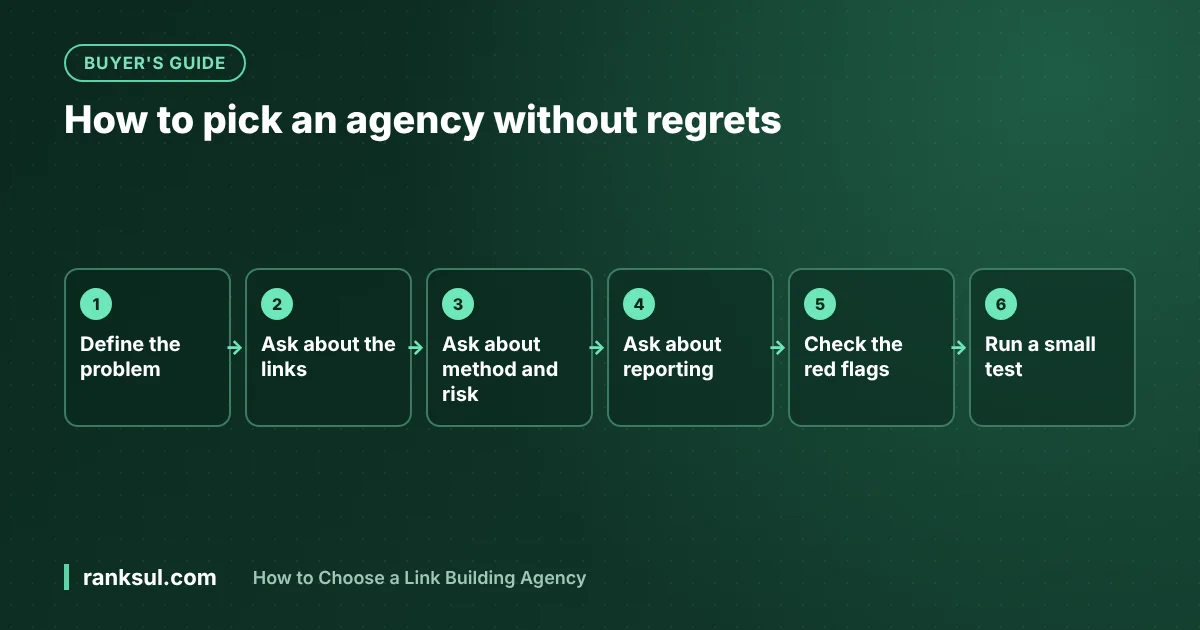
Links help pages that already deserve to rank: pages with useful content, a clear search intent and no technical barriers. If your site is slow, poorly indexed or thin, links will not fix it. Run a free SEO audit first, and list the five to ten pages you most want to rank. A good agency will ask for exactly that list.
Questions about the links themselves
These tell you what you are actually buying.
- 1. Can I see live examples on sites like the ones you will use for me?
- 2. Will I approve each site before you place a link?
- 3. What are the DR, DA and real organic traffic of each site, and where does that data come from?
- 4. Is each link do-follow or no-follow, and how is it marked?
- 5. Where in the article will the link sit, and who writes the article?
Questions about method and risk
These tell you how likely the work is to cause problems later.
- 6. Do you use private blog networks, link farms or sitewide links? (The only good answer is no.)
- 7. How do you choose anchor text, and how do you avoid over-optimised anchors?
- 8. How do you check a site is a real publication with its own readers?
- 9. What is your policy if a link is removed or the site is deindexed?
- 10. How do you handle Google's guidance on paid and sponsored links?
Questions about results and reporting
These tell you whether you will know if it is working.
- 11. What will you report, and how often? Can I see a sample report?
- 12. What should I expect at 3, 6 and 12 months for my pages and competitors?
- 13. Which metrics will we judge success by: rankings, organic traffic or leads?
- 14. What do you need from my team, and what happens if I pause?
- 15. Can I start small, with a handful of placements, before committing to a retainer?
Red flags that should end the conversation
Walk away if you hear any of these:
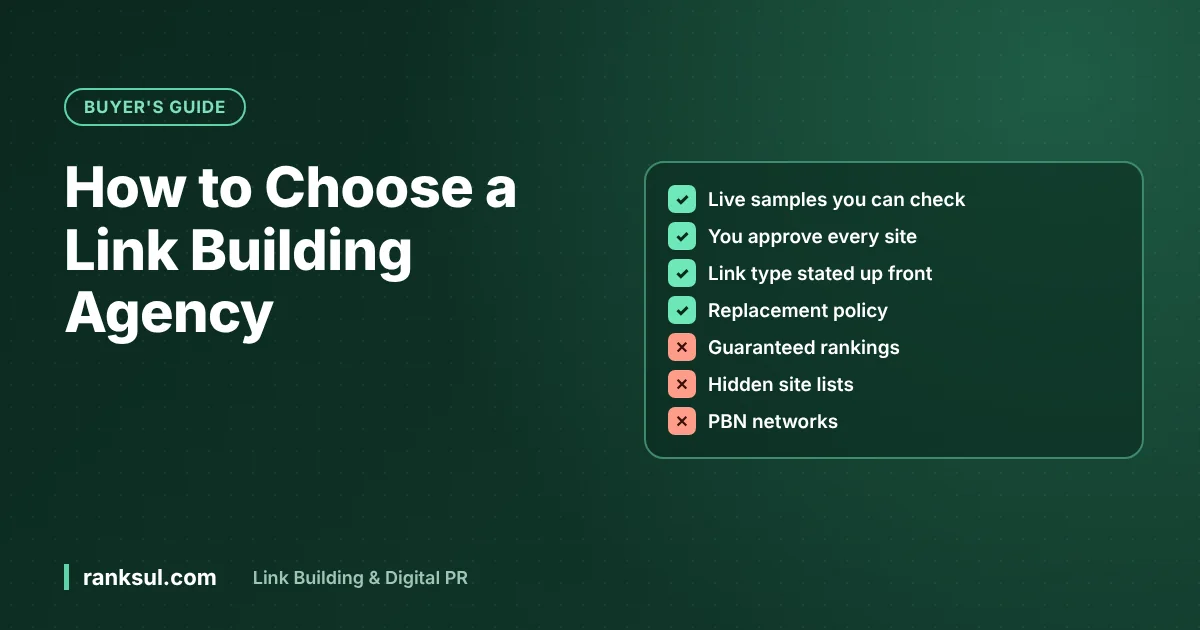
- A guaranteed ranking position or a guaranteed traffic number
- Hundreds of links for a few hundred dollars
- No live examples, or examples on sites with high DR but almost no traffic
- Refusing to tell you the sites until after payment
- Exact-match anchor text on every link
- Long contracts with no way to judge results in the first three months
What fair link building prices look like
Prices vary more than most buyers expect. Across 11,000+ publishers priced in dollars on our marketplace, the median placement costs well under $100, while DR 80+ news and business publications typically cost from several hundred to a few thousand dollars. Country matters too: markets with few publishers cost far more per link. Our Link Building Price Index breaks prices down by DR, traffic, country and niche, so you can tell a fair quote from an inflated one.
Retainer agencies price differently: a monthly fee covers strategy, outreach and reporting, and the number of links varies. Placement marketplaces price each link individually. Neither is better; the question is whether you want to choose sites yourself or pay for someone to run the whole program.
How Ranksul answers these questions
We wrote this guide as a buyer's checklist, and we hold ourselves to it. Our How Ranksul works page answers each question: you see every site's metrics and a live sample in the marketplace, approve sites and anchors before anything is placed, pay only for confirmed placements, and get a replacement if a link is removed within a year.
If you are comparing agencies, our overview of the best digital PR and link building agencies is a good place to start.
10 more questions most guides forget
The questions above cover links, method and results. These cover the practical details that decide whether the relationship works.
- Who exactly will work on my account, and are they employees or freelancers?
- Who writes the content, and can I review it before publication?
- Can I approve each site before a link is placed?
- Do you reuse the same sites for many clients, and how often?
- How do you choose anchor text for my pages?
- What happens if a link is removed or changed to no-follow?
- How do you report: live URLs, anchors, target pages, link types?
- Which tools do you use to vet sites (traffic, spam signals)?
- What is the minimum contract, and how do I cancel?
- Who owns the content and the relationships if we stop working together?
Pricing models and what each one hides
Agencies sell per link, per package or per month. Per-link pricing is easiest to compare. Packages often hide which sites you get until after you pay. Retainers can be good value for long campaigns, but ask for the typical number of live links per month and what happens when the target is missed. Convert every quote to cost per relevant live link and compare with marketplace prices in our Link Building Price Index.
Contract terms to check before you sign
- Notice period and minimum term
- Replacement or refund if links are removed within a set period
- Approval rights over sites and content
- Reporting frequency and format
- Confidentiality, especially for white-label work
- No guaranteed ranking claims (a guarantee is a red flag, not a benefit)
A simple scorecard for comparing proposals
Score each agency from 1 to 5 on each line, then compare totals. It turns a sales conversation into a decision you can explain to your team.
- Quality of sample live links (relevance, real traffic)
- Transparency: can you see and approve sites?
- Fit with your industry and markets
- Cost per relevant live link
- Reporting detail
- Replacement and contract terms
- Communication and who does the work
Run a small test first
Before a long contract, order a small batch of links to one or two pages. Check every link yourself: is the site real, relevant and indexed, does the article read well, is the link as agreed? After two to three months, look at the pages you linked. A good agency is happy to start this way.
Agency, freelancer, marketplace or in-house?
An agency suits businesses that want strategy and execution handled. A freelancer can be cheaper but depends on one person. A marketplace gives control and lower prices if you can judge sites. In-house outreach builds lasting relationships but takes time and skill. Many businesses combine two of these; see our comparison of marketplaces, agencies and manual outreach.
What a good link building report contains
- Every live URL, the publisher and its metrics at the time of placement
- Anchor text and the page each link points to
- Link type (do-follow, no-follow, sponsored) and whether the page is indexed
- Changes in rankings and organic traffic for the linked pages
- Links lost or changed, and what was done about them
- Next month's plan
Questions to ask yourself before hiring
Is links really your bottleneck? If your pages are thin, slow or not indexed, links will not fix them. Do you know which pages you want to rank? Can you wait three to six months for results? Do you have a budget for at least a few months? If the answer to any of these is no, fix that first or ask the agency to help with it.
Example: comparing two proposals
Agency A offers 10 links a month for $2,000 with "DR 50+" sites chosen by them and a monthly PDF. Agency B offers 6 links a month for $2,100 with a shortlist you approve, sample articles, traffic shown for each site and a one-year replacement guarantee.
Per link, A looks cheaper ($200 vs $350). But if half of A's sites have no real traffic and B's are all relevant, B delivers more value per dollar. This is why the scorecard above weighs transparency and relevance, not only price.
Frequently asked questions
How much should a link building agency cost?
Compare on cost per relevant live link. Agencies typically charge more per link than marketplaces because they include strategy, outreach and reporting; for marketplace benchmarks see the Link Building Price Index.
Should a link building agency guarantee rankings?
No. Rankings depend on Google, your site and your competitors. A guarantee is a sign the agency is overpromising.
How long should I give an agency before judging results?
Three to six months for rankings on the pages that received links. Judge the quality of the links themselves straight away.
How do I choose a backlink service provider?
Choose one that shows you the sites before you pay, with their real traffic, a live sample article on each and the price per site. The provider should show each link's type (do-follow, sponsored or no-follow) before you buy, explain what happens if a link is removed, and agree to a small test order first.
Avoid providers that hide the sites, guarantee rankings, or sell hundreds of links at one flat price.
Want Ranksul (ranksul.com) to execute this strategy for your domain?
Book a complimentary strategy call. We will audit your current topical authority, editorial backlinks, and content clusters.