PBN Links vs Manual Outreach: Why Contextual Placements Win (and How to Spot a PBN)
Private blog networks promise fast links; manual outreach earns links from real publications. Here is why contextual placements win, and how to run outreach that works.

Ranksul Team
SEO & Link Building Team
What PBNs are and why they are risky
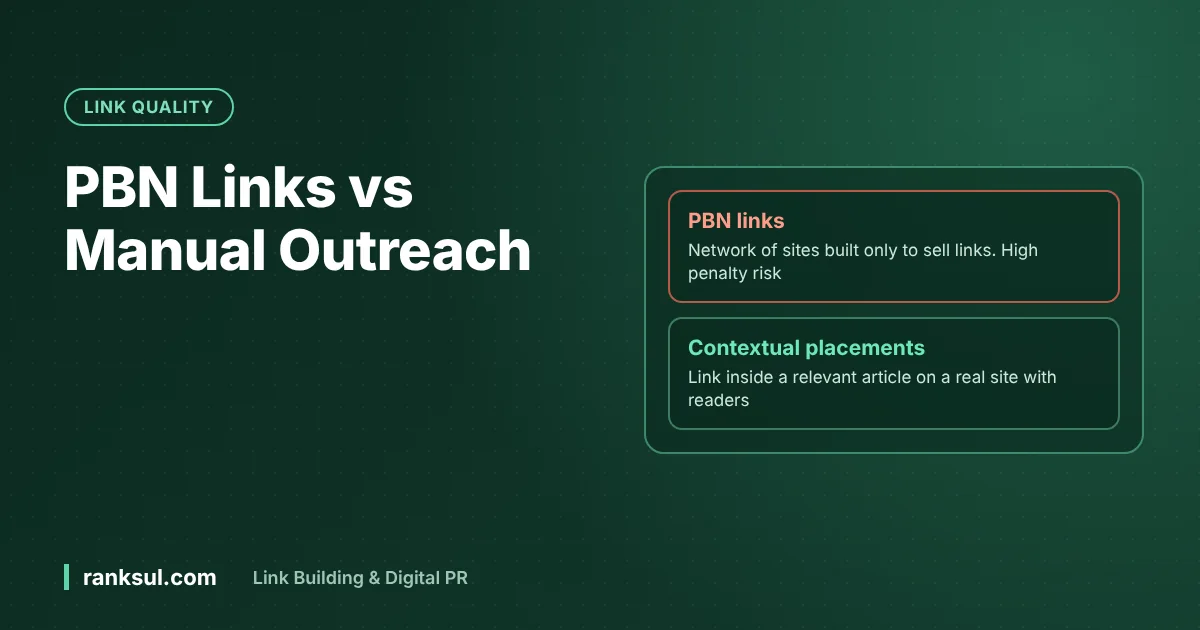
A private blog network (PBN) is a group of websites, often built on expired domains, that exist mainly to link to other sites. They may look like blogs, but they have little real audience and are controlled by one owner.
Google's spam policies describe link schemes, including sites created primarily to pass links, as spam. Systems like SpamBrain are designed to detect them, and links from detected networks can be ignored or lead to manual actions. Even when a PBN works for a while, the risk sits on your site.
- Many sites with similar designs and thin content
- Little or no organic traffic despite high DA or DR
- Outbound links to unrelated businesses in every post
- Expired domains with a history unrelated to the current content
What a contextual placement is
A contextual placement is a link inside the body of a relevant article on a real publication, surrounded by text about the same topic. It is the kind of link a reader might genuinely click, and the kind search engines treat as a recommendation.
This is the core of editorial link building: real sites, real readers and a link that makes sense in context. Ranksul's guest posting services and niche edits are both built around contextual placements.
How manual outreach works
Manual outreach means finding relevant sites, contacting a real editor with a personal pitch and offering something their readers will value: an expert article, data, a resource or a correction. It takes longer than buying from a network, but the links are earned on sites with genuine audiences.
Our manual outreach and blogger outreach services follow this process: prospecting by topic and traffic, vetting, personal pitches, original content and reporting every live link.
Why contextual placements win over time
Contextual links on real sites keep their value because the sites keep their value. They also bring referral traffic and brand exposure, which PBN links never do. And they protect you: when Google improves its spam detection, editorial links are what remain.
Paid placements are legitimate when they are disclosed as the publisher requires. Google asks for paid links to be qualified with rel="sponsored" or nofollow, as explained in its guide to qualifying outbound links. Ranksul lists each publisher's link type up front so you know exactly what you are getting.
Where to start
Browse real publishers with metrics and live samples in the Ranksul marketplace, or let our team plan a campaign for you. Read our modern link building blueprint for a step-by-step plan.
How to spot a PBN in 10 minutes
Sellers rarely call their sites a PBN. These checks catch most of them.
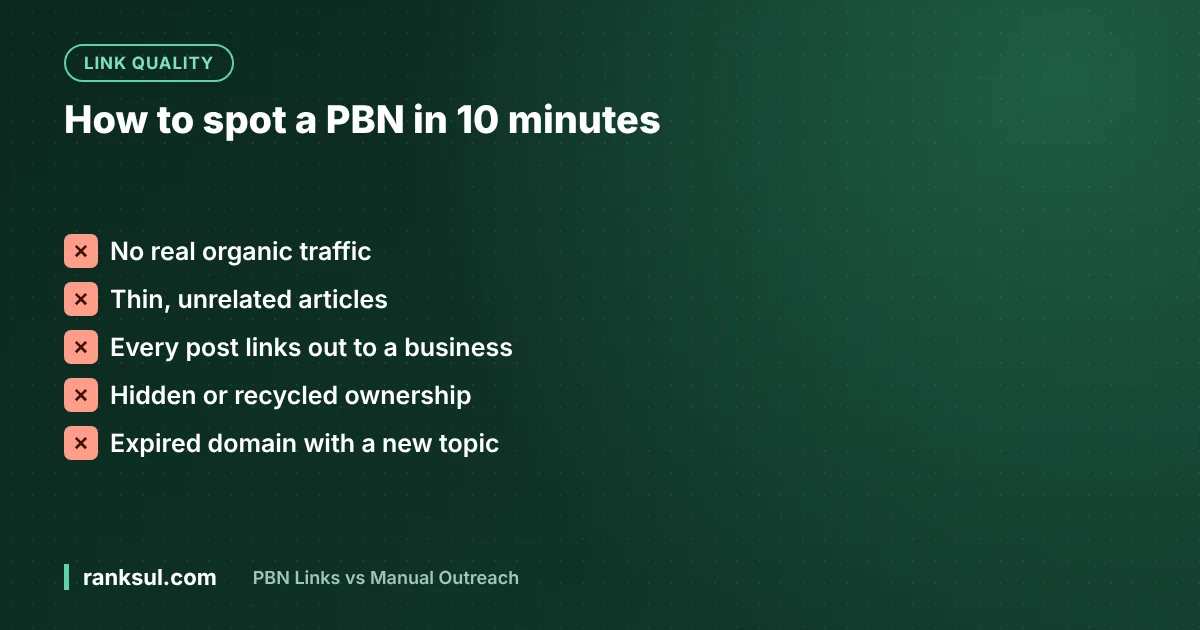
- Organic traffic is tiny or collapsing while DR or DA is high
- The site covers everything: crypto, pets, casinos and roofing in the same week
- Almost every post links out to a commercial site
- No real authors, about page or contact details
- The domain history shows a different business or language before (check archive.org)
- Several sites in the seller's list share the same theme, layout or hosting
- The site does not rank for its own name or topics
Why PBNs still get sold
PBN links can move rankings for a while, which is why they persist. But they are a liability: Google's systems are designed to detect link networks and can ignore every link from them at once, or apply a manual action. When that happens, the money is lost and rankings that depended on those links fall. Contextual placements on real sites do not carry that cliff-edge risk.
Manual outreach step by step
- Choose the page you want links for and the reason someone would link to it
- Build a list of relevant sites: resource pages, writers who cover your topic, sites linking to competitors
- Find the right person: the editor or author, not a generic inbox
- Write a short, specific email: what you noticed, what you offer, why it helps their readers
- Follow up once after about a week, then move on
- Track replies, placements and which angles work
Outreach email example
"Hi Anna, I read your guide to choosing CRM software for small agencies. The link to the pricing comparison in section 3 now returns a 404. We keep an up-to-date comparison of 14 CRMs with prices checked monthly, here: [link]. It might be a useful replacement. Either way, thanks for the guide. Sam"
It works because it is specific, helps the editor and asks for nothing unreasonable. Templates that open with "I love your blog" and ask for a link do not.
Outreach, placements or both?
Manual outreach builds links you cannot buy, but reply rates are low and it takes time. Contextual placements on vetted publications are fast and predictable. Most campaigns use placements for the pages that need links now and outreach for long-term relationships. Compare the options in our marketplace vs agency vs outreach guide.
What happens when a PBN is detected
There are three common outcomes. Most often, Google's systems simply stop counting the network's links, so rankings that relied on them fade, sometimes after a core or spam update. Sometimes the whole network is deindexed, which sellers try to hide by rebuilding on new domains. Occasionally the sites buying the links receive a manual action for unnatural links. In all three cases the money spent is lost.
Contextual placements: what to look for
- A real publication with its own readers and traffic from search
- Topic relevant to the page you are linking
- The link sits in the body of an article that would make sense without it
- The article is written for that site's audience
- The site does not link out to unrelated commercial sites in every post
- You can see a live sample before ordering
Outreach tactics that still get replies
Broken link replacement
Find dead links on relevant pages and offer your page as a replacement.
Resource page inclusion
Suggest your guide or tool for curated lists of resources on your topic.
Unlinked mentions
Ask sites that mention your brand to add a link.
Expert contributions
Answer journalist requests and contribute quotes to roundups in your field.
Data offers
Offer an updated statistic or chart to writers whose articles cite outdated numbers.
Frequently asked questions
Are all guest posts risky?
No. Guest posts on relevant, real publications with genuine audiences are a normal part of marketing. The risk comes from networks and low-quality sites built only to sell links.
How long does manual outreach take?
Usually a few weeks per campaign, because each placement is agreed with an editor. Marketplace placements on sites that already accept guest posts are faster.
How can I check whether a site is part of a PBN?
Look for real traffic, a consistent editorial focus, named authors and natural outbound links. If a high-DR site has no traffic and links to everything, walk away.
Are PBN links illegal?
No, but they break Google's spam policies, so they can be ignored or lead to a manual action against your site.
What should I do if I bought PBN links in the past?
Stop buying them, ask for removal where possible, and consider disavowing them if you have a manual action or a clear pattern of spammy links. Then focus on earning real links.
What is a good reply rate for outreach emails?
It varies widely by niche and offer. Personalised, genuinely useful pitches do far better than templates; measure your own and improve the angle rather than sending more emails.
Want Ranksul (ranksul.com) to execute this strategy for your domain?
Book a complimentary strategy call. We will audit your current topical authority, editorial backlinks, and content clusters.