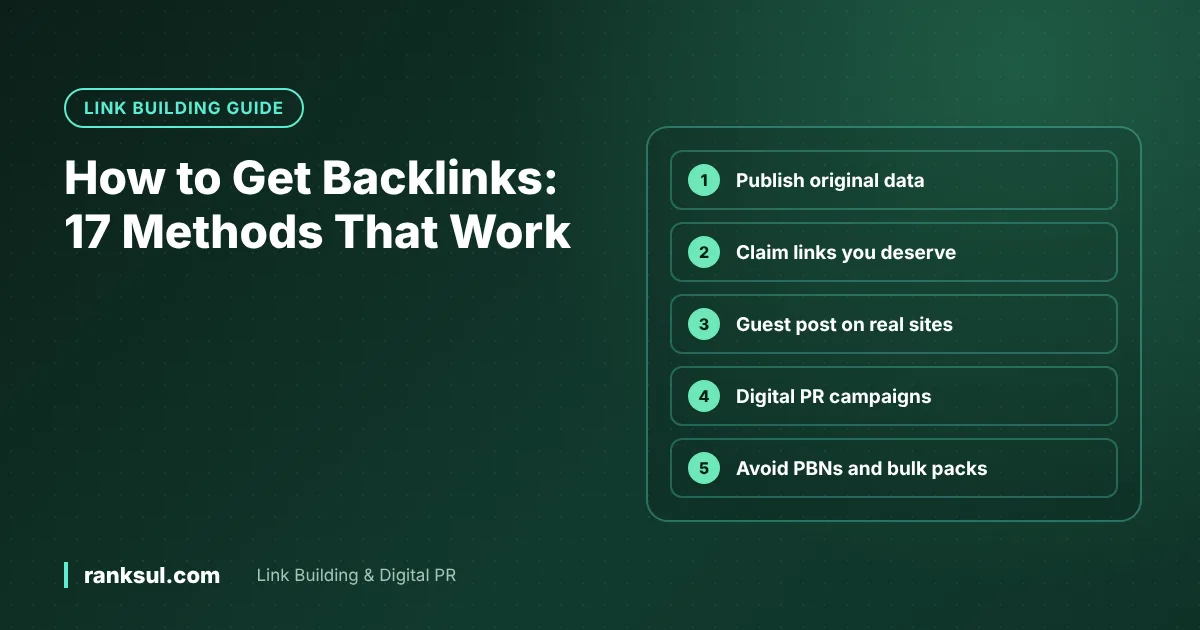
How to Get Backlinks: 17 Methods That Work, Ranked by Effort and Impact
Seventeen ways to get backlinks that still work, grouped into links you earn, links you build and links you buy, with the effort, cost and risk of each so you can pick the right mix for your site.

Ranksul Team
SEO & Link Building Team
What counts as a good backlink
A backlink is a link from another website to yours. Google treats it as a vote: a link from a respected site in your field tells it that your page is worth showing. Our guide to what a backlink is covers the types in detail.
Not every link is worth having. Before you chase any of the methods below, know what a useful link looks like:
- Relevant: the linking site writes about your subject or your customers' interests
- Real readers: the site gets organic traffic from Google, not just a high DR or DA score
- In context: the link sits inside an article, next to text that explains why it is there
- Natural anchor text: your brand name, the page title or a plain description, not the same keyword every time
- Indexed: Google shows the site's recent articles when you search site:domain.com
Links you earn (high impact, slower)
These are the links Google values most, because nobody was paid to give them. They take more work up front, but one good asset can keep earning links for years.
1. Publish original data
Journalists and bloggers need numbers to quote. A survey, an analysis of public data or an index built from your own records gives them a reason to link to you. We did this ourselves with the Link Building Price Index, built from prices of 11,707 publishers.
Keep the method transparent, publish the headline figures in the first paragraph, and update the data each year so the links keep coming.
2. Digital PR campaigns
Digital PR turns a story, data set or expert view into coverage on news and industry sites. A single strong campaign can earn dozens of links from publications you could never pitch one by one. Our step-by-step digital PR guide shows the campaign types that work best.
3. Answer journalists' requests
Reporters post requests for expert comment every day on services such as Qwoted, Featured and Help a B2B Writer, and on social media under hashtags like #journorequest. Answer quickly, stay on topic and give a quotable line with a credential. One answer in ten turning into a link is a good rate.
4. Create linkable tools and templates
Free calculators, checklists, templates and simple tools attract links from people who recommend them to their readers. They work best when they solve one problem quickly and need no sign-up.
5. Write the definitive guide on a narrow topic
Broad topics are crowded. A guide that becomes the best answer to a narrow question in your field gets cited by others writing about it. Look for questions where the current top results are thin, outdated or written by people without hands-on experience.
Links you already deserve (low effort, quick wins)
Most businesses are owed links they have never asked for. Start here, especially with a new website.
6. Business profiles and directories
Create complete profiles on Google Business Profile, LinkedIn, Crunchbase and the review sites in your industry, such as Clutch, G2, Capterra or Trustpilot. Each one gives Google a consistent picture of your business. Skip mass directory submissions: a handful of trusted, relevant profiles beats hundreds of low-quality ones.
7. Unlinked brand mentions
8. Partners, suppliers and clients
Companies you work with often have partner, supplier, integration or case study pages. Ask to be listed. Offering a testimonial for a supplier you genuinely use is another common way to get a link.
9. Broken link building
Find pages in your field that link to articles that no longer exist, then offer your own page as a replacement. Tools such as Ahrefs show broken outbound links on any site. It works best when your page truly covers the same topic as the dead one.
10. Reclaim links to old or moved pages
If you changed URLs or redesigned your site, links may now point to pages that return errors. Redirect each old address to the closest current page with a 301 redirect, and the value of those links comes back.
Links you build (medium effort, steady results)
These methods involve outreach: you contact a site and offer something useful in return for a mention.
11. Guest posting
Write a useful article for a site in your field, with a natural link back to a relevant page. Pick sites by real traffic and topic match, not by DR alone. Our guest post outreach guide includes pitch templates and examples.
12. Expert roundups and interviews
Podcasts, newsletters and industry blogs regularly feature practitioners. Being interviewed usually comes with a link to your site, and the audience is already interested in your field.
13. Resource page link building
Many sites keep pages of recommended resources for their readers. If your guide or tool genuinely belongs on such a page, a short email to the editor is often enough.
14. Skyscraper-style content updates
Find an article that many sites link to, publish a clearly better and more current version, and let the sites linking to the old one know. It only works when your version is genuinely more useful, not just longer.
Links you buy (fast, needs care)
Paying for placements is common, and Google is clear about the rule: a link that was paid for should carry rel="sponsored" or rel="nofollow". Paid placements still bring readers, brand visibility and mentions that AI answers pick up. What you must avoid is buying links on sites built only to sell them.
15. Sponsored articles on real publications
A sponsored article on a respected site in your niche puts your brand in front of its readers. In the Ranksul marketplace the typical placement costs $80, and half of all publishers charge between $43 and $215. Our sponsored posts page explains how they work.
16. Niche edits
A niche edit adds a link to an article that is already published and indexed. It is faster than a new guest post and the page may already have its own backlinks. See niche edits vs guest posts for when each makes sense.
17. Press release distribution
Press releases syndicated to news sites are good for brand visibility, credibility and being found in news search. The links in them usually carry little ranking value on their own. Use them for genuine news, not as a link tactic. Our article on whether press releases help SEO covers the details.
Which methods to start with
For a new website, start with the links you already deserve (methods 6 to 10). They are free, quick and build trust. Then publish one piece of original data or a definitive guide, and promote it through outreach and digital PR.
If you need results within a few months, add a small number of guest posts or sponsored articles on relevant sites with real traffic. Spread them over time, link to different pages and vary the anchor text. Our link building strategy blueprint shows how to plan the mix month by month.
Methods to avoid
Some tactics still circulate because they are cheap. They rarely help, and some can earn a manual action from Google's spam team:
- Private blog networks (PBNs): sites built only to link out. See our guide on how to spot a PBN
- Bulk packages promising hundreds of links for a low fixed price
- Large-scale link exchanges ("I'll link to you if you link to me")
- Comment and forum spam with keyword anchors
- Site-wide footer or sidebar links bought on unrelated sites
Frequently asked questions
How many backlinks do I need to rank?
There is no fixed number. Look at the pages ranking on page one for your target search in Ahrefs or Semrush and count how many different websites link to them. That tells you roughly what you need, and quality and relevance matter more than the count.
How long do backlinks take to work?
Google usually needs to crawl the linking page first, which can take days to a few weeks. Ranking changes often show after one to three months, and new websites tend to take longer than established ones.
Can I get backlinks for free?
Yes. Business profiles, unlinked mentions, partner pages, journalist requests, original data and guest posts can all be done without paying anything except your time.
Are paid backlinks against Google's rules?
Google's spam policies say links that were paid for should be marked rel="sponsored" or rel="nofollow". Buying links meant to pass ranking value without that label is against its guidelines. Sponsored placements on real sites are still useful for visibility and readers.
What is the fastest way to get backlinks?
Claiming the links you already deserve is fastest. After that, guest posts and sponsored articles on relevant sites are the quickest to arrange: most publishers in our marketplace deliver within a week.
Want Ranksul (ranksul.com) to execute this strategy for your domain?
Book a complimentary strategy call. We will audit your current topical authority, editorial backlinks, and content clusters.