Is Guest Posting Still Safe in 2027? What Google's Policies Actually Say
Google's site reputation abuse policy made many marketers nervous about guest posting. Here is what the policy actually targets, where the real risks are, and how to choose publishers safely.

Ranksul Team
SEO & Link Building Team

The short answer
Yes, guest posting is still a normal part of marketing in 2026, as long as it is done on relevant, real publications with genuine editorial standards. What Google acts against is publishing designed mainly to manipulate rankings: networks of sites that exist to sell links, large volumes of off-topic articles on unrelated sites, and links that pass ranking credit in exchange for payment without being disclosed.
Two of Google's spam policies matter most here: site reputation abuse and link spam.
What site reputation abuse means
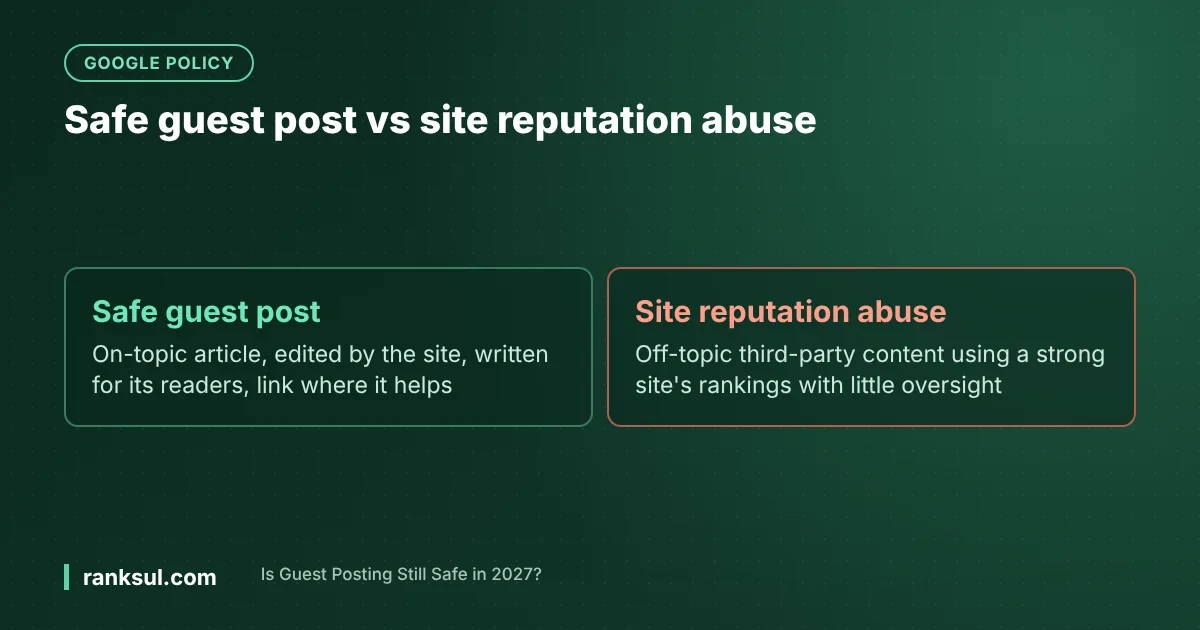
Site reputation abuse is when third-party pages are published on a site mainly to take advantage of that site's ranking signals, with little oversight from the host. Typical examples are coupon, casino or payday-loan sections hosted on a news or university website that has nothing to do with those topics. Google clarified in late 2024 that even first-party involvement does not make such content acceptable if its purpose is to exploit the host's reputation.
A relevant guest article, written for the publication's own readers and edited by its team, is a different thing. The policy is about the pattern of hosting unrelated content for ranking purposes, not about the existence of contributed articles.
What the link spam policy says about paid links
Google's link spam policy treats buying or selling links that pass ranking credit as a violation. Its guidance on qualifying outbound links asks sites to mark paid or sponsored links with rel="sponsored" (or rel="nofollow"). Since 2019 Google has treated these attributes as hints rather than strict rules.
In practice this means two things. First, sponsored placements on reputable publications still bring visibility, referral traffic and brand mentions, which also matter for AI search. Second, authority built through earned coverage, such as manual outreach and digital PR, carries the least risk.
Safety checklist for choosing a guest post site
Before you place an article, check the publisher against this list. The Ranksul marketplace shows most of these details for each site, including live sample articles.
- The site covers your topic or a closely related one
- Organic traffic is real and stable (check it in Ahrefs or Semrush, not just DR)
- Articles are edited, with real authors and a clear editorial focus
- The site does not publish large numbers of unrelated "sponsored" posts every day
- The link type is stated honestly: Do-Follow, No-Follow or Sponsored
- Recent sample articles are live and indexed in Google
Red flags to avoid
- A "write for us" page offering any topic for a fixed price
- High DR with almost no organic traffic, often an expired domain
- Many outbound links in every article to casinos, loans or unrelated niches
- A network of near-identical sites run by the same seller
- Promises of guaranteed rankings
How Ranksul handles it
We list publishers with their DA, DR, traffic, link type and sample articles so you can judge relevance yourself, remove sites whose samples no longer load, and back placements with a 1-year replacement warranty. For more depth, read manual outreach vs PBNs and how to choose DA and DR metrics, or see our guest posting service.
Does guest posting still work for SEO?
Yes, when it is done for readers. A relevant article on a site your customers read can bring referral traffic, brand trust, mentions that AI answers pick up, and a link that helps a specific page rank. What stopped working is the volume model: hundreds of thin articles on sites that exist to sell posts, each with a keyword anchor.
Surveys of SEO practitioners now tend to rank digital PR above guest posting as a link tactic, but guest posting remains widely used because it is predictable and lets you target specific pages. The two work best together.
Guest posting vs sponsored posts vs paid links
A guest post is an article you contribute to another site. Some are unpaid and accepted on merit; many are paid (often called sponsored posts). Google does not object to sponsored content as such; it objects to paying for links that pass ranking credit without being qualified. Its guidance asks for paid links to use rel="sponsored" (or nofollow).
In practice, publishers decide how they mark links. The safe approach is to treat every placement as something you would be comfortable with Google seeing: relevant, useful, honestly labelled where the publisher requires it, and with natural anchor text.
How to write a guest post that publishers accept
- Read the site first: match its topics, tone, length and formatting
- Pitch one specific idea that fills a gap in its existing articles
- Write for its readers, with examples and practical steps, not a sales pitch
- Include one link to your site where it genuinely helps the reader
- Link to other useful, non-competing sources as well
- Use a natural anchor: your brand, the page title or a descriptive phrase
Anchor text: the most common way guest posts go wrong
Google's spam policies specifically mention guest posting campaigns with keyword-rich anchor text links. Repeating "best running shoes" as the anchor in every article is a pattern that is easy to detect. Use branded anchors, the page's name or descriptive phrases, and save exact-match anchors for the occasional place where they read naturally.
How to measure a guest post
Check that the article is indexed and the link is live and as agreed. Then look at referral visits in your analytics, the ranking and organic traffic of the page you linked to over the next three months, and whether the site's audience matches your customers. Over time, keep a list of which publishers produced movement and reuse them.
How to find guest post opportunities
- Search "[topic] + write for us", "[topic] + guest post guidelines" or "[topic] + contribute"
- Look at where competitors and industry experts have contributed (search their names + "guest post")
- Check which sites AI assistants cite for your topic; they are trusted sources worth appearing on
- Use a marketplace to see vetted publishers with metrics, link types and samples
- Ask partners, suppliers and associations whether they publish contributed articles
Pitch template for a guest post
"Hi [name], I enjoyed your piece on [recent article]. Your readers seem to want practical [topic] advice, and I noticed you have not covered [specific gap]. I'd like to write '[working title]': [two-line outline]. I'm [role] at [company] and have [specific experience]. Happy to follow your guidelines and send a draft. [Name]"
Short, specific and about their readers. Attach nothing; offer to send a draft.
Guest posting mistakes that cost the most
- Choosing sites by DA or DR alone, without checking traffic and topic
- Using the same exact-match anchor in every article
- Publishing the same article on several sites
- Linking only to the home page
- Ignoring the host site's readers and writing an advert
- Never checking whether placements stay live
Frequently asked questions
Can a guest post get my site penalised?
A single relevant article on a real publication is very unlikely to cause problems. Risk grows with patterns: many paid links from unrelated sites, exact-match anchors and link networks.
Should guest post links be No-Follow?
If a link is paid, Google asks for rel="sponsored" or rel="nofollow". Editorial links you earn without payment can be followed. Our page on Do-Follow backlinks explains the difference.
Is digital PR safer than guest posting?
Earned coverage is generally the lowest-risk way to build authority, and the two work well together. See our digital PR breakdown.
Is guest posting illegal?
No. It is a normal publishing practice. Some countries require advertising to be disclosed, so paid articles may need to be labelled as sponsored.
How many guest posts per month is safe?
There is no safe number. What matters is relevance, quality and natural anchors. A few good placements a month that match your activity look natural; dozens of low-quality ones do not.
Do guest posts help with AI search visibility?
They can. AI answers often cite sources that are already trusted and mention brands that appear across relevant sites, so useful articles on respected publications support AI visibility too.
How much does a guest post cost?
On the Ranksul marketplace, the median placement costs about $80 including writing; strong publications cost several hundred dollars or more.
Want Ranksul (ranksul.com) to execute this strategy for your domain?
Book a complimentary strategy call. We will audit your current topical authority, editorial backlinks, and content clusters.