Guest Post Outreach in 2027: 7 Pitch Examples, Templates and a Process That Gets Replies
How to find sites worth pitching, what editors want to see in the first two lines, seven real-world pitch examples with notes on why they work, follow-up timing, and how to keep guest post links inside Google's rules.

Ranksul Team
SEO & Link Building Team
What guest post outreach is, and what changed in 2026
Guest post outreach is the work of finding websites in your field, pitching them an article idea, and getting that article published with a mention or link back to you. It sits inside the wider practice of link outreach, which also covers asking for link insertions, fixing broken links and turning unlinked brand mentions into links. For the other ways to earn links, see how to get backlinks.
The basics have not changed: editors want articles that help their readers, written by someone who knows the subject. What has changed is the volume. AI writing tools mean editors receive more pitches than ever, most of them generic. That is good news if you do the opposite: a short, specific pitch from someone who has clearly read the site now stands out more than it did five years ago.
Guest posts also matter beyond Google. AI answers in ChatGPT, Gemini and Google's AI Overviews repeat what credible sites say about a brand, so a byline on a respected publication in your niche helps you get mentioned there too. Our generative engine optimization guide explains how that works.
Guest post outreach email template (copy and paste)
Replace everything in brackets with real details about the site you are pitching. The template only works when the second sentence proves you read the site.
Subject: Guest post idea: [working title]
"Hi [editor's first name], I enjoyed your recent piece on [article topic], especially [one specific point]. One thing your readers might want next is [gap or follow-up question]. I would like to write [working title] for [site name]: [one or two lines on what it covers]. I am [role] at [company] and have [one line of relevant experience or data]. Would this work for your audience? Thanks, [your name]"
Keep it under 150 words, send it to a named person rather than a generic inbox, and follow up once after five to seven days. The seven examples below adapt this template for different situations.
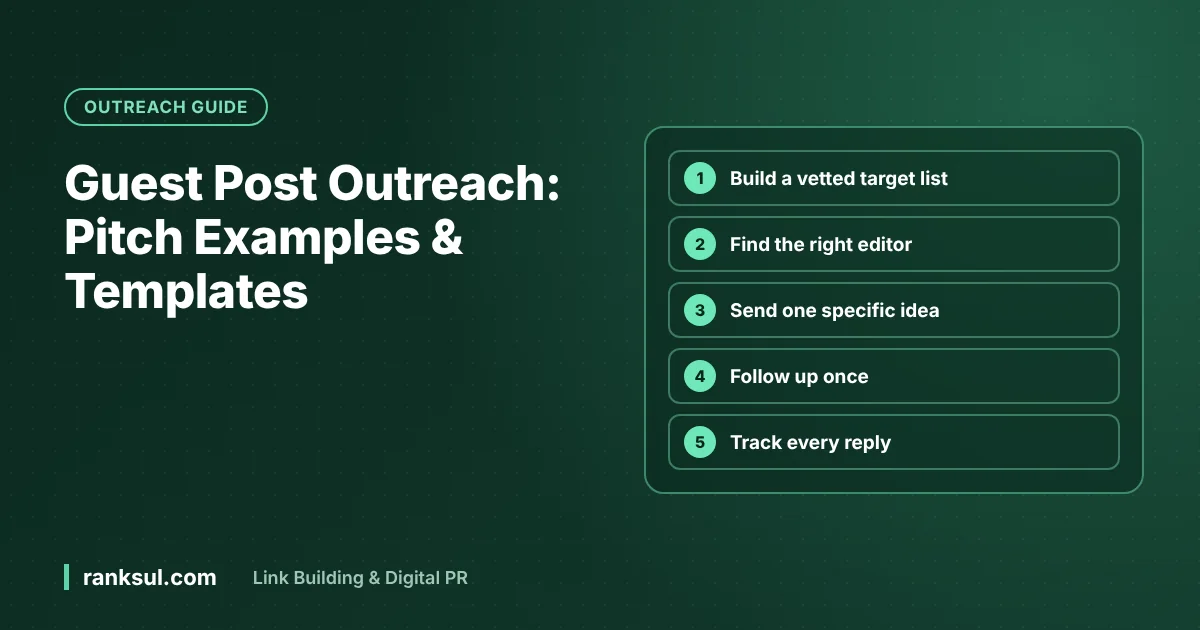
Step 1: Build a target list worth pitching
Outreach succeeds or fails on the list. Pitching 200 random "write for us" pages wastes more time than pitching 30 sites you have checked. We see this in our own data: across the 11,707 publishers in the Ranksul marketplace, a site's Ahrefs DR is only loosely related to how much organic traffic it really gets, so a high score on its own tells you little about whether anyone reads the site.
For each candidate site, check these before you write a word (our guide on how to evaluate a guest post site covers each check in more depth):
- Organic traffic: a few thousand monthly visits or more from search, and a stable or rising trend in Ahrefs, Semrush or Similarweb
- Topic match: the site regularly publishes on your subject, not just one stray article
- Indexing: search Google for site:domain.com and confirm recent articles appear
- Editorial quality: articles are edited, have real author bylines and are written for readers
- Outbound links: no long lists of unrelated casino, loan or pill links in recent posts
- Guidelines: a contributor or "write for us" page, and whether they accept links in guest articles
Step 2: Find the right person to pitch
Send the pitch to the person who decides. On larger sites that is the section editor or content manager, not the general info@ address. Check the contributor guidelines first: many sites ask for pitches through a form or a specific address, and ignoring that is the fastest way to be deleted.
If there are no guidelines, look for the editor's name on the masthead, the About page or LinkedIn, then use an email finder to confirm the address. On small blogs the owner is usually the editor, and a personal note works far better than a formal one.
Step 3: Write a pitch editors actually read
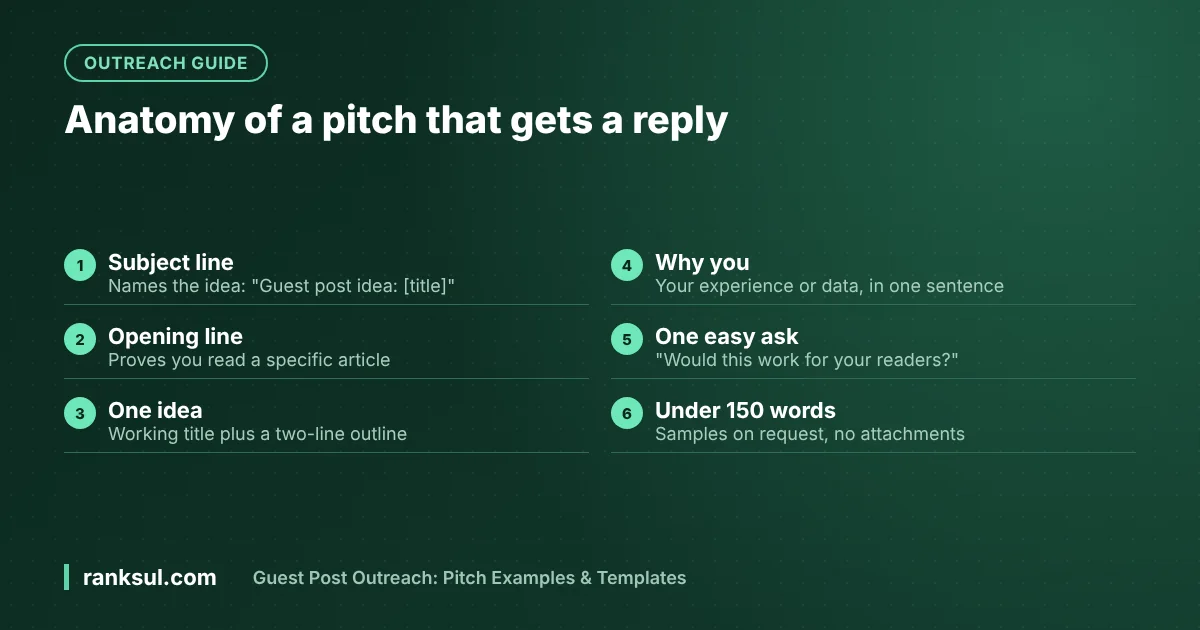
Editors decide in seconds. The pitches that get replies share the same five parts, in this order:
- A subject line that names the idea, such as "Guest post idea: How to price SEO retainers in 2027", not "Collaboration" or "Guest post"
- An opening line that proves you read the site, referring to a specific recent article and what it left out
- One idea, with a working title and two or three lines on what the article will cover
- Why you: one sentence on the experience or data that makes you the right person to write it
- One easy ask that can be answered with yes or no, such as "Would this work for your audience?"
Keep it under 150 words
Long pitches read like templates. If the editor wants your writing samples or an outline, they will ask. Link to one or two previous articles at most, and never attach a full draft unless the guidelines ask for one.
7 guest post pitch examples, with notes on why they work
These examples are written for different situations. Replace the details in brackets and, more importantly, the specifics: a pitch only works when the observations are real.
1. The gap pitch
Subject: Guest post idea: [Working title]
"Hi [Name], your guide to [topic] is one of the clearest I have read, especially the part on [specific point]. One question it does not cover is [gap], which your readers ask about in the comments. I would like to write [working title] for you: [two-line outline]. I run [role] at [company] and have [specific experience]. Would this be useful for your readers?"
Why it works: it proves the writer read the article, names a real gap and offers to fill it without asking the editor to change anything.
2. The update pitch
Subject: Your [topic] post: two figures have changed
"Hi [Name], your post on [topic] still gets shared, but two things in it have changed since [year]: [fact 1] and [fact 2]. I could write an updated companion piece, [working title], with the current figures and sources, or simply send you the corrections for the original. Which would help more?"
Why it works: it gives value first. Even if the editor says no to the article, you have started a relationship.
3. The original-data pitch
Subject: New data on [topic] for your readers
"Hi [Name], we analysed [dataset, e.g. prices from 5,000 publishers] and found [one surprising finding]. Nobody has published this yet. I would like to write an article for [site] that walks through the findings and what they mean for [audience]. Happy to share the full data with you first."
Why it works: editors want things their competitors do not have. Original numbers are the strongest pitch you can make. Our Link Building Price Index started this way.
4. The experience pitch
Subject: What we learned from [specific experience]
"Hi [Name], I have [done the thing] for [time] at [company], including [specific result]. Your readers are mostly [audience], and I think they would get a lot from a practical piece on [working title]: the three mistakes we made, and what we would do differently. Would you be interested?"
Why it works: first-hand experience is what generic AI content cannot fake, and it is exactly what Google's guidance on helpful content asks for.
5. The client placement pitch (for agencies)
Subject: Article for [site]: [working title]
"Hi [Name], I work with [client], a [type of business] that knows [topic] well. We would like to contribute [working title] for your readers, written by [expert at client]. The article would include one link to [client] where it is genuinely useful. If you charge for contributed articles or mark such links as sponsored, just let me know your terms."
Why it works: it is honest about the client link and the commercial context, which saves both sides time and keeps the link inside Google's rules.
6. The broken link or resource pitch
Subject: Broken link on your [page title] page
"Hi [Name], I was using your [resource page] and noticed the link to [resource] now returns a 404. We published [your resource], which covers the same ground and is up to date, in case it is a useful replacement. Either way, thought you would want to know about the broken link."
Why it works: this is link outreach rather than guest posting, but it is the easiest yes in outreach because you are fixing a problem the editor has.
7. The follow-up
Subject: Re: Guest post idea: [Working title]
"Hi [Name], just checking whether my idea below fits your plans. If the topic is not right, I would be happy to suggest a different angle on [related subject]. Thanks either way."
Why it works: it is short, adds a new option instead of repeating the pitch, and is easy to answer.
Subject lines that get opened
The subject line decides whether the pitch is read. Name the idea, keep it under about 60 characters and avoid anything that looks automated.
- Guest post idea: [Working title]
- Article for [site]: [Working title]
- New data on [topic] for your readers
- Your [topic] post: two figures have changed
- Question about your [article title]
- Broken link on your [page title] page
- Avoid: "Collaboration opportunity", "Quick question", "Guest post", ALL CAPS and emoji
Follow-up rules: when to send and when to stop
Send one follow-up five to seven business days after the first email, as a reply in the same thread so the editor sees the original pitch. If there is still no reply, move on and try a different site or a different idea a few months later.
More follow-ups rarely change the answer and can get your domain marked as spam, which hurts every future pitch. When an editor says no, thank them and ask whether there is a topic they would like covered. That question often leads to a yes.
Link outreach beyond guest posts
Guest posts are one form of link outreach. The others are often faster because you ask for less:
- Link insertions: ask a site to add your resource to an existing article where it genuinely helps the reader
- Broken link building: point out dead links and offer your page as the replacement
- Unlinked mentions: when a site mentions your brand without a link, ask them to add one
- Resource pages: suggest your guide or tool for curated lists of resources
- Expert quotes: answer journalist requests on platforms such as Qwoted or Featured to be quoted with a link
Track outreach like a sales pipeline
Use a spreadsheet or outreach tool with one row per site: site, contact, date pitched, idea, follow-up date, status (no reply, declined, accepted, published), live URL and link type. After 30 to 50 pitches you will see which types of site and which kinds of idea get replies.
Measure the cost of each live link, including your time. If a writer spends ten hours finding sites, pitching, writing and chasing one placement, that link costs far more than it seems. For comparison, the median placement in the Ranksul marketplace costs $80 including the article, with the publisher's metrics and a live sample shown before you order. Many teams combine the two: outreach for the sites that matter most, and the marketplace for the rest.
Stay inside Google's rules
Guest posting is not against Google's rules. Google's spam policies do, however, list large-scale guest posting campaigns with keyword-rich anchor text links as a link scheme, and they expect any link that is paid for, with money, products or services, to be marked rel="sponsored" or rel="nofollow".
In practice: write for sites that cover your topic, use your brand name or a natural phrase as the anchor text, never ask for exact-match anchors at scale, and be open about any payment. Sites that publish anything for anyone also risk Google's site reputation abuse policy, which our article on whether guest posting is still safe explains in detail.
Common guest post outreach mistakes
- Pitching sites that do not cover your topic, just because they have a high DR
- Sending the same template to hundreds of sites with only the name changed
- Opening with praise that could apply to any site ("I love your blog!")
- Pitching several ideas at once instead of one strong one
- Hiding that an article is for a client, or that you expect a link
- Asking for exact-match keyword anchors
- Following up three or four times
- Not recording which sites said no, and pitching them again a month later
Do it yourself, hire a service, or use a marketplace?
Doing outreach yourself gives you full control and the best relationships, but it takes time: expect to pitch many sites for every article accepted. A managed blogger outreach service runs the whole process for you, from prospecting to writing and follow-ups. A marketplace lets you skip the pitching and choose from sites that already accept articles, with their traffic, link type and price shown up front.
At Ranksul we offer all three routes: manual outreach for sites that have to be won one by one, guest posting services where we write and place the articles, and a marketplace of 11,707 publishers in 42 countries. Every placement is confirmed with the publisher before you pay and replaced if it is removed within a year.
Guest post template: how to structure the article
Once the editor says yes, this structure fits most guest posts and makes approval faster.
- Title: the working title you pitched, sharpened to match the main search
- Opening: two or three sentences that state the problem and promise the answer
- Body: three to six sections with descriptive subheadings, each answering one question
- Evidence: your own data, examples or screenshots, with sources for any figures
- Links: one or two to genuinely useful sources, and at most one to your own site where it helps
- Close: a short summary or next step for the reader, not a sales pitch
- Author bio: two lines with your name, role and relevant experience
Guest post samples: what editors want to see
Editors who ask for samples want proof you can write for their audience. Send one or two published articles in the same topic and tone, not your best-performing post on an unrelated subject. If you have none yet, publish one strong article on your own blog or LinkedIn first and use that.
Frequently asked questions
What is guest post outreach?
Guest post outreach is the process of finding relevant websites, pitching them an article idea and getting the article published with a mention or link to your site. It is one part of link outreach, which also includes link insertions, broken link building and unlinked mentions.
How long should a guest post pitch be?
Under 150 words. Name the idea in the subject line, show you read the site, describe one article idea in two or three lines, say why you are the right person to write it and end with one simple question.
How many times should I follow up on a guest post pitch?
Once, five to seven business days after the first email, as a reply in the same thread. If there is no answer after that, move on.
Should I send a full draft or just an idea?
Send the idea first unless the site's guidelines ask for a complete draft. Editors want to shape the article to their audience, and you avoid writing something that is not accepted.
Are guest post links still good for SEO?
Yes, when the article is on a relevant, well-read site and written for its readers. Links from large-scale guest posting with keyword-rich anchors can be treated as a link scheme, and paid links should be marked rel="sponsored".
What reply rate should I expect from guest post outreach?
Reply rates vary widely with how well you target and personalise, and generic cold pitches usually get very few replies. Track your own reply and acceptance rates per type of site and idea, and improve the list before you improve the template.
Is there a guest post email template I can copy?
Yes. The seven pitch examples above work as guest post email templates: copy the one that fits your situation, then change the details so the email clearly refers to the site you are pitching. A guest post outreach email template only works when the editor can tell it was written for them.
What should a guest post outreach email include?
A subject line that names the idea, one line proving you read the site, the article idea with a working title, one sentence on why you are the right writer and a simple yes-or-no question. Keep it under 150 words.
How do I pitch a guest post to a website?
Find the editor responsible for the topic, read their recent articles, then send a short pitch with one specific idea that fills a gap on their site. Follow up once after five to seven days, then move on.
Want Ranksul (ranksul.com) to execute this strategy for your domain?
Book a complimentary strategy call. We will audit your current topical authority, editorial backlinks, and content clusters.