How to Rank in Google AI Overviews and Get Cited by Perplexity: The 2027 Playbook
Google's Search Generative Experience grew into AI Overviews, and assistants like Perplexity cite sources in every answer. Here is a step-by-step playbook to become one of those sources.

Ranksul Team
SEO & Link Building Team
From SGE to AI Overviews
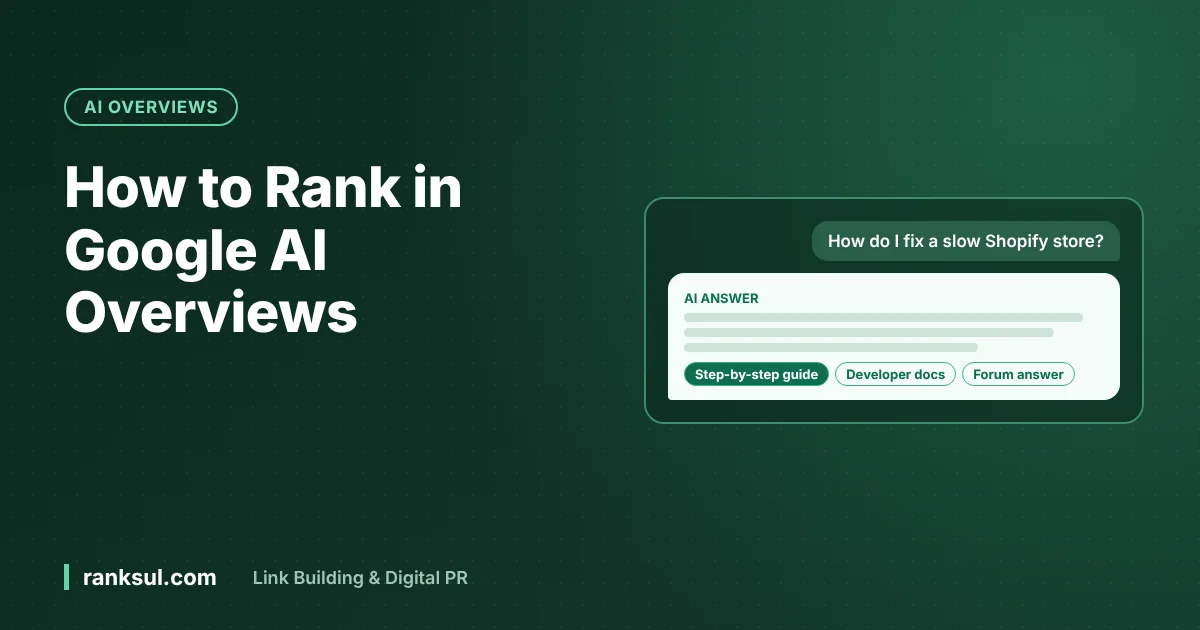
Google tested AI-generated answers as the Search Generative Experience (SGE) and launched them as AI Overviews. Other assistants, such as Perplexity, ChatGPT search and Gemini, also answer with a summary and a list of sources. For websites, the question has changed from "do we rank?" to "are we one of the sources the answer cites?".
Google's documentation on AI features and your website says the same SEO best practices apply and there are no extra technical requirements. That is good news: the playbook builds on work you may already be doing.
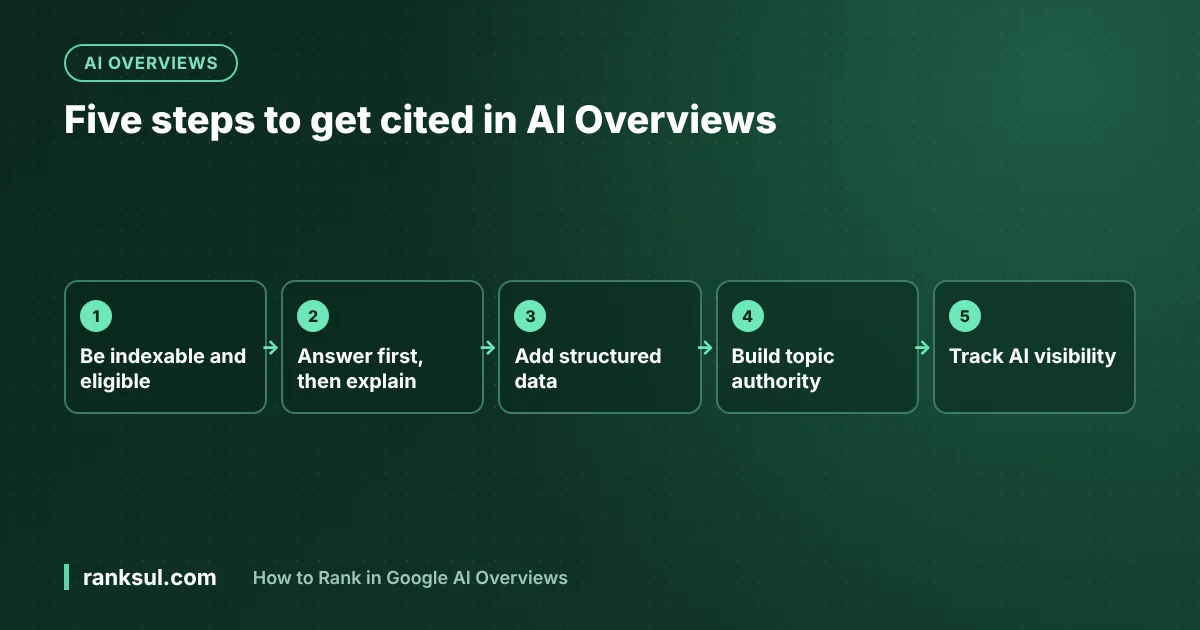
Step 1: be indexable and eligible
A page has to be indexed and allowed to show a snippet to appear in AI Overviews. Check indexing with the URL Inspection tool in Google Search Console, make sure important text is in the HTML rather than loaded late by JavaScript, and avoid nosnippet on pages you want quoted.
For other assistants, check robots.txt for the crawlers you want to allow; Google lists its crawlers in the overview of Google crawlers. Our technical SEO work covers both.
Step 2: answer first, then explain
AI answers lift short, clear statements. Under each question-style heading, give a direct one or two sentence answer, then add the detail: steps, examples, numbers and caveats. Use tables for comparisons, numbered lists for processes and plain language throughout.
- Question-style headings that match how people ask
- A direct answer in the first sentence under each heading
- Specific facts, figures and named methods you can support
- Tables for comparisons and lists for steps
- An FAQ section for related questions
Step 3: add structured data
Structured data using Schema.org vocabulary tells search engines what a page is: an article, a product, an organisation, a how-to. It does not guarantee a citation, but it reduces ambiguity, and accurate Organization data helps search engines connect your brand to its website and profiles.
Step 4: build authority around the topic
When several pages answer a question equally well, the cited source is often the one with more authority on the topic. Build topic clusters so your site covers a subject in depth, as described in our topical authority guide, and earn links and mentions from respected publications.
Digital PR, news site placements and editorial link building all strengthen the signals AI systems and search engines use. Browse publishers by topic in the Ranksul marketplace.
Step 5: track AI visibility
Keep a list of prompts your customers ask and check monthly whether you are cited. Our guide to AI SEO and LLM visibility tools compares ways to automate this. Pair it with impressions and clicks in Search Console to see whether AI visibility is growing with classic rankings.
How AI Overviews choose which pages to cite
Google has said AI Overviews and AI Mode use its core ranking systems and show links to pages that support the answer. In practice, pages already ranking on page one for the query, or for related queries, are cited most often.
AI Mode can split a question into several related searches ("query fan-out") and cite pages that rank for each, which means a page ranking for a narrower sub-question can be cited even if it does not rank for the main query.
That gives two routes in: rank for the main question, or be the clearest page for one of its sub-questions. The second route is often easier for smaller sites.
Write for query fan-out
List the follow-up questions someone would have about your topic: cost, comparison, steps, risks, alternatives, "for small businesses", "in the UK". Give each one its own clearly headed section with a direct answer. Our own articles follow this pattern: each section answers one question in its first sentences.
Content formats AI Overviews quote
- A one- or two-sentence definition directly under the heading
- Numbered steps for "how to" questions
- Short comparison lists or tables for "X vs Y"
- Price ranges with what drives them for "how much" questions
- Pros and cons for "is X worth it" questions
- A dated, sourced statistic for "how many/what share" questions
What not to do
Do not block Googlebot from content you want cited, hide answers behind interactions that do not render, or use nosnippet/max-snippet rules on pages you want quoted: Google respects those controls in AI features too. Avoid writing pages that only exist to target AI answers; thin pages written for machines tend to fail both readers and rankings.
Do AI Overviews reduce clicks?
For simple factual questions they often do, because the answer is on the results page. For commercial and complex questions, being cited still drives visits, and the visitors tend to be further along in their research. Track impressions and clicks in Search Console for queries that show AI Overviews, and judge by conversions as well as clicks.
Example: an answer-first section
Question heading: "How long does link building take to work?"
Answer-first opening: "Link building usually takes three to six months to show in rankings. Pages already on page two move fastest; very competitive keywords take longer."
Then the detail: why it takes time (discovery, indexing, evaluation), what speeds it up, and how to measure progress. The opening two sentences are what an AI Overview can quote; the detail is what makes the page worth citing.
AI Overviews checklist
- Page indexed, no nosnippet or restrictive max-snippet rules
- Main question answered in the first sentences
- Sub-questions covered under their own headings
- Specific facts with sources and dates
- Author and organisation information visible
- Internal links from related pages
- Mentions and links on sites that rank for the topic
AI Overviews vs AI Mode
AI Overviews appear at the top of normal results for some searches, with links to supporting pages. AI Mode is a separate, conversational search experience that answers longer and follow-up questions, often drawing on more sources through query fan-out. The same fundamentals apply to both: indexed, eligible pages that answer questions clearly, from sites with authority on the topic.
Which searches show AI Overviews
They appear most often for informational and complex questions ("how", "why", "what is the difference") and less often for navigational searches and many simple commercial ones. Local searches usually still show the map pack. Check your own target queries: if they show AI Overviews, structure pages for citation; if they do not, classic rankings and snippets still decide clicks.
Getting cited in Perplexity and ChatGPT search
These tools retrieve pages live and favour clear, recently updated, well-sourced pages. Allow their crawlers (PerplexityBot, OAI-SearchBot) in robots.txt, keep publication and update dates visible, and make sure Bing has indexed your pages, since several AI tools draw on Bing's results. Mentions on sites they already cite for your topic raise your chances.
Frequently asked questions
Does FAQ schema get me into AI Overviews?
No markup guarantees inclusion. FAQ content helps because it answers questions clearly; the markup only describes it.
Do AI Overviews reduce clicks?
For some simple questions, yes. Being cited keeps your brand visible, and detailed or commercial queries still send clicks to the sources.
Where should I start?
Pick ten pages that answer important questions, rewrite their openings to answer directly, check indexing, and build links to them. A free SEO audit can help you choose.
Do I need special schema for AI Overviews?
No. Google says no special markup is required. Structured data still helps search engines understand your page, so keep it accurate and matched to visible content.
Can a page that ranks on page two be cited?
Yes, sometimes, especially if it is the clearest answer to a related sub-question. But higher rankings improve the odds.
How do I know if my site appears in AI Overviews?
Search Console includes AI Overview appearances in normal performance data without a separate filter, so track your target queries manually or with an AI visibility tool.
Want Ranksul (ranksul.com) to execute this strategy for your domain?
Book a complimentary strategy call. We will audit your current topical authority, editorial backlinks, and content clusters.