Enterprise SEO in 2027: Strategy, Platforms and How to Scale Organic Growth
Large websites lose rankings in ways small sites never see: crawl waste, duplicate templates, slow releases and scattered links. Here is how enterprise SEO platforms help, and how to build a stack that scales.

Ranksul Team
SEO & Link Building Team
What is enterprise SEO?
Enterprise SEO is search engine optimisation for large organisations: sites with tens of thousands of pages, several brands, markets or languages, and many teams who can change the site. The goals are the same as for any SEO, but the work is different. An enterprise SEO strategy has to win budget and developer time, set rules that stop releases from breaking rankings, and measure results across many sections and countries.
What an enterprise SEO platform actually does
An enterprise SEO platform is software that monitors, analyses and reports on search performance for websites with tens of thousands to millions of URLs. Where a small business can check a few pages by hand, a large retailer, marketplace or publisher needs automation: scheduled crawls, rank tracking across thousands of keywords, alerts when templates break and dashboards that different teams can trust.
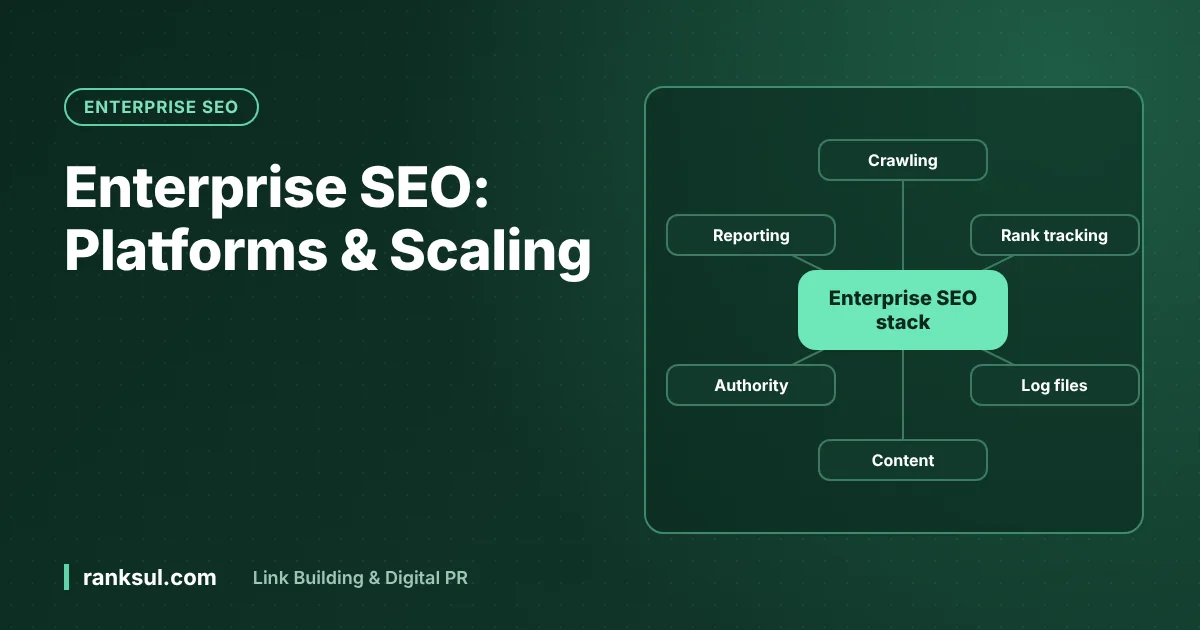
Most platforms cover the same core jobs: crawling the site the way a search engine does, tracking rankings and visibility, analysing server logs to see what Googlebot really requests, auditing content for duplication and thin pages, and reporting results to stakeholders. The difference between tools is scale, integrations and how well they fit the way your teams ship changes.
Why large websites need a platform, not a spreadsheet
On a large site, one template change can affect thousands of pages at once. A developer removes a canonical tag, a CMS update adds noindex to a category, or faceted navigation suddenly creates millions of crawlable URLs. Without automated monitoring, these problems are found weeks later in falling traffic.
Google explains in its guide to managing crawl budget for large sites that crawling is limited for very large or fast-changing sites. Platforms help you see where crawl activity is wasted and which important pages are crawled too rarely, so you can fix internal linking, sitemaps and parameter handling.
- Scheduled crawls that compare each run with the last one
- Alerts for status code, canonical, noindex and title changes on key templates
- Log file analysis to see what Googlebot actually crawls
- Rank and visibility tracking by section, country and device
- Integration with Google Search Console and analytics data
Building your enterprise SEO stack
Start with free, first-party data. Google Search Console shows impressions, clicks, indexing status and Core Web Vitals for your own property, and Bing Webmaster Tools does the same for Bing. These are the only sources that report what the search engines themselves see.
Add a crawler such as Screaming Frog or a cloud crawler for very large sites, and a research suite such as Ahrefs or Semrush for competitor analysis, keyword research and backlink data. Enterprise platforms then sit on top, joining this data into dashboards and workflows for content, engineering and marketing teams.
If you do not have an in-house team for every part, our SEO services and technical SEO work can cover audits and fixes while your team focuses on product.
Content at scale without thin pages
Enterprise sites often generate pages automatically: product variants, location pages, filtered categories. These can rank well when each page answers a real search with unique information, and they can drag the whole site down when they are near-duplicates. Google's guidance on creating helpful, people-first content applies to templates as much as to articles.
Use your platform to find pages with no impressions, duplicate titles or very little unique text, then decide whether to improve, merge or remove them. For the pages that matter, invest in SEO content writing and a clear topical authority architecture so related pages support each other.
Authority: the part platforms cannot automate
Platforms measure links; they do not earn them. When two large sites have similar technical health and content, the one with stronger, more relevant backlinks usually wins the competitive terms. Enterprise brands earn those links through digital PR, research, partnerships and editorial placements on real publications.
Ranksul's publisher marketplace lists 11,000+ websites with their DA, DR, traffic, link type and, for many, a live sample article, so enterprise teams can choose placements by section and market. For ongoing campaigns, our editorial link building and digital PR services plan placements around the pages that drive revenue.
Measuring what matters
Report on business outcomes, not just rankings. Tie organic sessions and conversions from Google Analytics 4 to the sections you are improving, and track visibility for keyword groups that map to revenue. Review crawl health, indexing and Core Web Vitals monthly, and link growth to priority pages quarterly.
If you are not sure where your site stands, request a free SEO audit. We review technical health, content and backlinks and send you a prioritised list of fixes.
Why enterprise SEO stalls
- SEO tickets compete with product work and lose without a business case
- Many teams publish content with no shared standards
- Releases break SEO elements (canonicals, noindex, redirects) without anyone noticing
- Several sites or country versions compete for the same keywords
- Reporting shows rankings, not revenue, so leadership loses interest
A prioritisation framework that gets work shipped
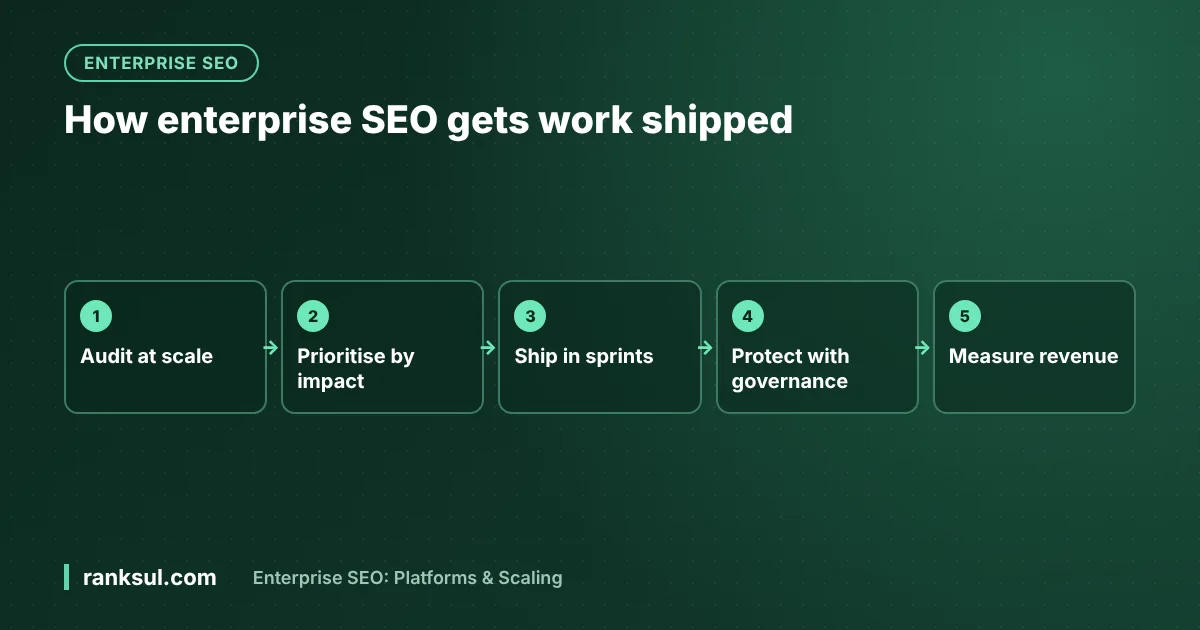
Score every SEO opportunity on impact (traffic or revenue at stake), effort (engineering time), confidence (evidence it will work) and reach (how many pages it affects). On large sites, the winners are almost always template-level changes: a fix to a product template improves thousands of pages at once. Present the top items with an estimated revenue impact, not an SEO score.
Technical issues that only appear at scale
Faceted navigation and parameters
Filters can create millions of URLs. Decide which combinations deserve indexable pages and keep the rest out of the index with canonicals, robots rules or by not linking them.
Crawl budget and log files
Server logs show which URLs Googlebot actually crawls. On large sites, a big share often goes to low-value URLs; fixing that speeds up discovery of new and updated pages.
International sites
Hreflang errors, duplicate country versions and automatic redirects by IP can hide pages from the markets they serve.
JavaScript rendering
Content that only appears after client-side rendering may be indexed late or not at all. Server-side or static rendering for key templates removes the risk.
SEO governance: protecting what you have
Add SEO checks to the release process: automated tests for titles, canonicals, robots directives and structured data on key templates, and alerts when indexable pages drop or response codes change. Give content teams a short standard (one topic per page, internal links, no duplicate pages) and a way to check for existing pages before creating new ones.
Choosing an enterprise SEO platform
- Crawls at your scale, on a schedule, including JavaScript rendering
- Segments by template, section, country and business unit
- Integrates Search Console, analytics and log files
- Alerts on changes after releases
- Rank and AI visibility tracking across markets
- Security and access controls (SSO, permissions) your company requires
- API access for your own dashboards
Building the business case for SEO work
Leadership approves work that ties to revenue. For each proposal, estimate the affected pages, their current traffic and conversion value, the expected change (based on a test or comparable fix) and the engineering cost. Where possible, test a change on a subset of pages first, measure the difference against a control group, and use the result to justify the full roll-out.
Enterprise SEO team models
Centralised teams set standards and run technical SEO for the whole company; embedded specialists sit in product or regional teams; hybrid models combine a small central team with champions in each team. Whichever model you use, give SEO a seat in release planning, not only in reporting.
Enterprise SEO software and solutions
Enterprise SEO software usually combines a site crawler that can handle millions of URLs, rank tracking by market and page group, log file analysis, and alerts when a release changes titles, canonicals or indexing. An enterprise SEO software platform earns its cost when it connects those signals to the teams that own each section of the site.
No enterprise SEO solution replaces the work itself. Software finds problems and tracks progress; people still have to prioritise fixes, write content and earn links. Treat enterprise SEO management as a process with owners and deadlines, and the platform as the tool that keeps it honest.
Choosing an enterprise SEO company or firm
An enterprise SEO company should show experience with sites of your size and complexity, explain how it will work with your developers and content teams, and report on results by section and market. Ask any enterprise SEO firm for examples of migrations or large technical fixes it has handled, and how it earns links for brands that cannot risk low-quality placements.
Ranksul works with enterprise teams on the part platforms cannot automate: authority. See our enterprise link building service for how we plan brand-safe placements across many markets, and our technical SEO work for large sites.
Enterprise SEO vs regular SEO: what changes
- Scale: thousands to millions of URLs, so fixes are made to templates, not pages
- Keyword targeting: whole topic areas across products, brands and markets, not a handful of terms
- Stakeholders: developers, product, legal and regional teams all change the site
- Governance: release checks so a deployment cannot quietly remove rankings
- Tools: crawlers, log analysis and rank tracking built for large sites
- Cross-channel: SEO works with PR, paid search, content and product teams
Enterprise SEO best practices
- Prioritise by revenue impact and effort, and ship a few fixes well rather than many partly
- Turn SEO requirements into developer tickets and release checks
- Create content to a quality bar, and prune or merge pages that add nothing
- Keep facts about the brand consistent across every site, market and profile
- Earn links and mentions on publications your customers trust, in every market
- Report on results by section and country, in terms the business uses
Enterprise SEO and AI search
AI answers draw on the same pages that rank, so enterprise SEO now includes how the brand appears in ChatGPT, Gemini and Google AI Overviews. Consistent entity information, structured data, clear product pages and mentions on trusted publications all help. Our guide to LLM visibility covers how to measure it.
What makes an SEO platform scalable
A scalable SEO platform keeps working as the site grows from thousands to millions of pages, and as more teams use it. Check four things: how many URLs it can crawl and how often, how many keywords and markets it tracks, whether reports can be split by section or team without manual work, and whether data can flow out through an API.
Also check the price model. Some platforms charge by crawled URLs, others by tracked keywords or seats, and costs can jump when a site or team grows.
Common enterprise SEO platforms and what they are known for
These are widely used platforms, grouped by the job they are best known for. Features change often, so confirm details in a demo with your own site:
- Technical crawling and log analysis: Botify and Lumar
- Content and search performance at scale: BrightEdge, Conductor and seoClarity
- All-in-one research and tracking with enterprise plans: Semrush Enterprise and Ahrefs Enterprise
Frequently asked questions
Do I need an enterprise SEO platform if I already have Ahrefs or Semrush?
Research suites are excellent for keywords, competitors and backlinks. Enterprise platforms add large-scale crawling, change monitoring, log analysis and team workflows. Sites with tens of thousands of pages and several teams shipping changes usually benefit from both.
What is the most important first step for a large website?
Make sure the pages that earn money are crawled, indexed and fast. Check indexing and Core Web Vitals in Google Search Console, fix template-level issues, then build content and links around those pages.
Can link building work for enterprise brands?
Yes, when it is relevant and editorial. Placements on respected publications in your industry and markets strengthen the pages you link to. See high DA backlinks for how we choose sites.
What is the difference between enterprise SEO and regular SEO?
The principles are the same; the difference is scale and organisation. Enterprise SEO deals with very large sites, many stakeholders and change management.
Which enterprise SEO platform is best?
The one that fits your site size, team and integrations. Shortlist two or three, run them on your own site for a trial period and compare on the checklist above.
What does an enterprise SEO company do?
It plans and runs SEO for large sites: technical audits at scale, governance so releases do not break rankings, content programs across many sections, link building, and reporting by market and page group.
What are the limitations of Google Search Console for enterprise SEO?
Search Console is free and comes straight from Google, but it was not built for very large sites. The web reports export at most 1,000 rows, data is kept for 16 months, rare searches are hidden for privacy, and complete daily figures take about two days. It shows nothing about competitors.
Large sites work around this by splitting the site into several properties by folder, using the API or the bulk data export to BigQuery, and adding a crawler and rank tracker for what Search Console cannot show.
Want Ranksul (ranksul.com) to execute this strategy for your domain?
Book a complimentary strategy call. We will audit your current topical authority, editorial backlinks, and content clusters.