DR vs DA: The Differences, Which to Trust, and Safe Ranges for Link Building
DR (Ahrefs) and DA (Moz) are the first numbers everyone checks, and the easiest to misread. Here is how they differ, how often they disagree across 10,806 real publishers, and the checks that actually keep link building safe.

Ranksul Team
SEO & Link Building Team
What DA and DR measure
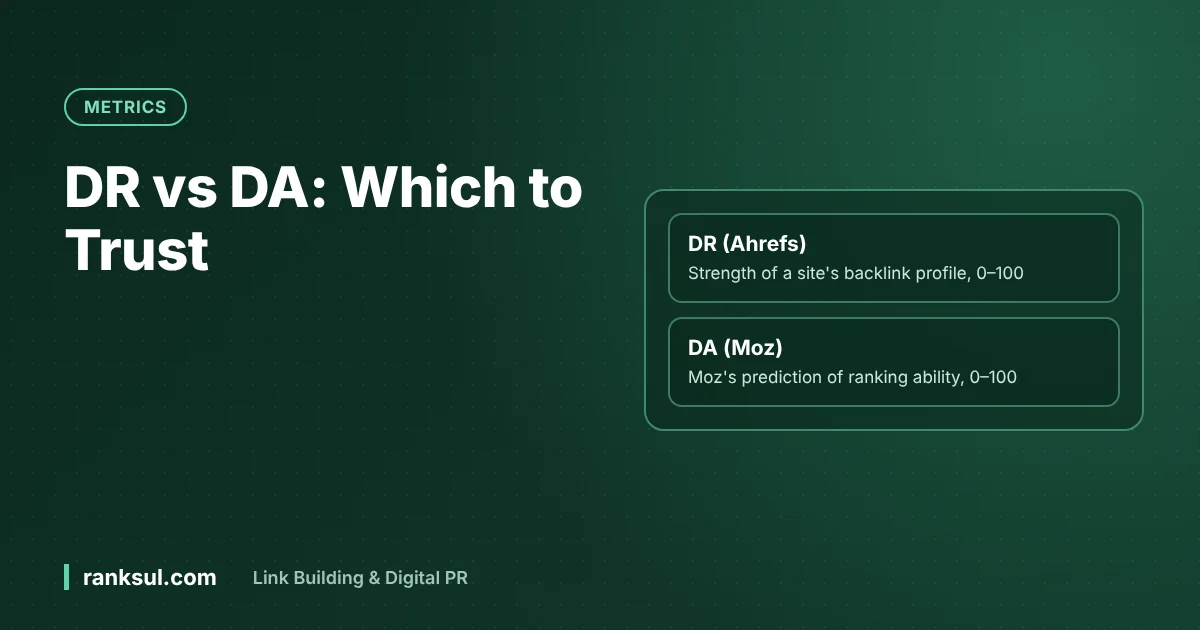
Domain Authority (DA) from Moz and Domain Rating (DR) from Ahrefs are scores from 0 to 100 that estimate how strong a website's backlink profile is compared with other sites. They are calculated by those tools from their own link data, and Google does not use them.
They are still useful: a site with strong links tends to pass more value through its own links. That is why the Ranksul marketplace shows both DA and DR for every publisher, alongside traffic and link type.
DR vs DA: the key differences
Both scores run from 0 to 100 on a logarithmic scale, so moving from 70 to 80 is far harder than moving from 20 to 30. Beyond that, they are built differently.
Domain Rating (DR), by Ahrefs
DR measures the strength of a site's backlink profile relative to every other site in the Ahrefs index. It looks at how many unique websites link to the site with followed links, and how strong those linking sites are themselves. Many links from one domain count about the same as one link from it, and no-follow links are not counted.
Domain Authority (DA), by Moz
DA is a machine-learning score from Moz that predicts how likely a site is to rank, compared with other sites, based on its link profile in the Moz index. Because it is a model trained on rankings rather than a direct link count, it can move when Moz retrains the model even if your links have not changed.
Why the numbers disagree
Ahrefs and Moz crawl the web separately, so they find different links, update at different speeds and weigh them differently. A site with a few very strong links can score higher on DR; a site with many links from mid-strength sites can score higher on DA. Neither is wrong: they answer slightly different questions with different data.
- DR: link strength, from unique followed referring domains (Ahrefs index)
- DA: predicted ranking ability, from a model of the link profile (Moz index)
- Both: 0–100, logarithmic, third-party estimates that Google does not use
What 10,806 real publishers tell us about DR vs DA
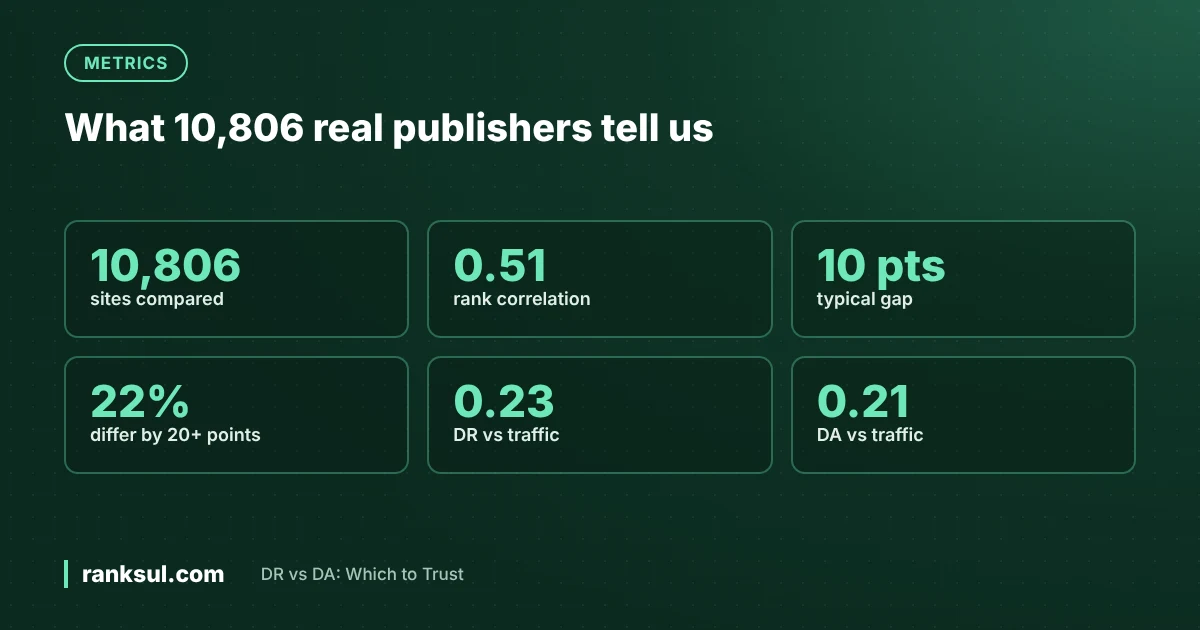
We compared DA and DR for every publisher in the Ranksul marketplace that has both scores: 10,806 websites, from small niche blogs to national newspapers.
The two scores move together, but loosely: their rank correlation is 0.51. The typical gap between them is 10 points, and on 22% of sites the gap is 20 points or more. DR was the higher score on 57% of sites and DA on 40%.
Neither score predicts a site's real readership well. The rank correlation with organic traffic was only 0.23 for DR and 0.21 for DA. Prices track both scores, DA a little more closely (0.55) than DR (0.47). See the full price breakdown in our Link Building Price Index.
The practical conclusion: if a seller quotes only one score, check the other one and the traffic. A large gap between DA and DR is a reason to look more closely at the site's links.
Why high numbers can mislead
Because DA and DR are based on links, they can be inflated with links, including spam. Expired domains often keep a high score long after their audience is gone, and some networks manufacture high-DR sites purely to sell links. A DR 80 site with no organic traffic is not a bargain; it is a risk.
- High DA or DR but organic traffic near zero
- Traffic that dropped sharply and never recovered
- Every post links out to unrelated commercial sites
- No clear topic, authors or editorial standards
The checks that matter more
Use DA and DR to build a shortlist, then check each site. Look at organic traffic and its trend in Ahrefs or Semrush, which keywords it ranks for, whether it covers your topic, and what its recent articles look like. Read a sample post: would a real reader find it useful?
Relevance often beats raw authority. A DR 50 site that covers your industry and ranks for related keywords can do more for you than a DR 80 general site that covers everything.
- Organic traffic that is real and stable
- Rankings for keywords related to your topic
- Topical relevance to the page you are linking
- Natural outbound links and editorial content
- A live sample article you can read before ordering
What DR range should you target?
There is no single right range. A natural link profile has a mix: some strong publications, many relevant mid-authority sites and a few smaller niche blogs. Brands in competitive markets often prioritise high DA backlinks from DR 70+ publications for their main pages, supported by relevant mid-range sites.
Our marketplace includes a minimum DR filter, and our editorial link building team balances authority, relevance and anchor text for each campaign.
Link type and disclosure
Check whether a site offers Do-Follow or No-Follow links, and price them accordingly. Google asks for paid links to be marked with rel="sponsored" or nofollow, as described in its guide to qualifying outbound links; many publishers follow their own policies. Ranksul lists each site's link type and prices Do-Follow backlinks and No-Follow links separately.
Other authority metrics you will see
DR and DA are not the only scores. Semrush's Authority Score combines link data with organic traffic and spam signals. Majestic's Trust Flow and Citation Flow measure link trust and link volume separately, and a large gap between them can signal spammy links. All of them are third-party estimates, so use them the same way: as filters, not verdicts.
How to check DR and DA for free
Ahrefs offers a free website authority checker for DR, and Moz offers a free domain analysis tool for DA with limited daily checks. Many marketplaces, including Ranksul, show both for every publisher so you do not need to check site by site.
Worked example: two sites, same DR
Imagine two sites with the same score. Site A: DR 62, 85,000 monthly organic visits, ranks for 9,000 keywords about home renovation, publishes two articles a week with named authors. Site B: DR 62, 900 monthly organic visits, ranks for 120 keywords on random topics, every recent post links to a casino, loan or crypto site.
Same DR, completely different value. Site A is a real publication; a link there brings readers and a trusted signal. Site B is selling its score. This is the most common trap in link buying, and why we show traffic and live samples next to DR and DA for every publisher.
DR, UR, DA, PA and Authority Score at a glance
Five scores come up when people judge a site. None of them comes from Google; each is a third-party estimate built on that company's own link index.
- Domain Rating (DR), Ahrefs: the whole domain, 0 to 100 on a logarithmic scale, based on followed links from unique domains, weighted by the linking sites' own DR
- URL Rating (UR), Ahrefs: the same idea for one page, counting the links pointing at that page
- Domain Authority (DA), Moz: the whole domain, 1 to 100, a machine-learning prediction of how likely the site is to rank
- Page Authority (PA), Moz: the page-level version of DA
- Authority Score (AS), Semrush: 0 to 100, combining backlink data with organic traffic and spam signals, which makes it harder to inflate with links alone
Is Ahrefs more accurate than Moz?
Neither is accurate in the sense of matching Google, because Google publishes no domain score. They measure different things. Ahrefs DR measures the strength of a site's backlink profile and reacts quickly when links are found or lost. Moz DA predicts ranking potential, so it moves more slowly and also shifts when Moz retrains its model.
In practice, use whichever tool you already pay for and compare sites within that one tool, never a DR from one with a DA from the other. In our data the two disagree by a wide margin on about one site in five, which is why we always check organic traffic alongside either score.
Why your DR dropped or your DA changed
DR is relative. It can fall when you lose links, when the sites linking to you lose authority, or simply when other sites gain links faster than you. A drop of a few points with stable traffic is usually nothing to worry about.
DA changes when Moz finds new or lost links to your site, and when Moz updates the model behind the score. A change in DA with no change in your rankings or traffic is a change in the tool, not in how Google sees you.
Page-level scores matter more than domain scores
Google ranks pages, not domains. A page with strong links of its own (a high UR or PA) can outrank a page on a site with a higher DR. When you buy a placement, the domain score tells you about the site; the page and the article your link sits in decide how much that link is worth.
Frequently asked questions
Is DA or DR better?
Neither is better; they use different link indexes. Looking at both, plus traffic, gives a more reliable picture than either alone.
Does Google use DA or DR?
No. They are third-party estimates. Google uses its own signals, which is why real traffic and relevance matter more.
Why is my DA higher than my DR (or the other way round)?
Because Moz and Ahrefs find different links and score them differently. In our data the two differ by 10 points on a typical site and by 20 or more on about one site in five, so a gap is normal. A very large gap is worth investigating.
What is a good DR or DA?
It depends on your competitors, not on a fixed number. Compare your scores with the sites ranking for your keywords. For link sources, a relevant site with real traffic matters more than any particular score.
How do I increase DR and DA?
Earn links from more unique, relevant and strong websites, through useful content, digital PR and editorial placements. Many links from the same few domains add little. Both scores follow real link growth over time.
What is a safe minimum DR?
There is no universal minimum. A relevant site with real traffic is safer than a high-DR site with none. Start with sites that pass the checklist above.
Do AI search engines use DA or DR?
No AI search provider has said it uses either score. Google says a page needs to be indexed and eligible for a normal search snippet to appear in AI Overviews, so the same quality and authority signals apply.
Which updates faster, DR or DA?
DR, in general. It moves as Ahrefs finds new or lost links, while DA is a model output that shifts more gradually and when Moz retrains it.
Want Ranksul (ranksul.com) to execute this strategy for your domain?
Book a complimentary strategy call. We will audit your current topical authority, editorial backlinks, and content clusters.