SEO and Content Marketing: How to Combine Them for Traffic That Lasts
SEO without content has nothing to rank; content without SEO is rarely found. Here is how to plan, write, distribute and update content so it keeps earning traffic.

Ranksul Team
SEO & Link Building Team
Why SEO and content need each other
Content marketing creates articles, guides and resources that help your audience. SEO makes sure the right people find them in search. When the two work separately, teams publish articles nobody searches for, or optimise pages that say nothing new. A content-led SEO strategy joins them from the start.
How SEO and content marketing work together
Content and SEO are two halves of one job. Content marketing creates the guides, comparisons and resources your audience needs; SEO decides which of them people are searching for and makes sure search engines can find, understand and rank them. Content without SEO is rarely found. SEO without content has nothing to rank.
- SEO finds the demand: the searches, questions and intent behind them
- Content meets it: pages that answer those searches better than anyone else
- SEO makes it findable: titles, structure, internal links, speed and structured data
- Content earns the links: useful resources are what other sites cite
- Both are measured together: traffic, leads and revenue per page
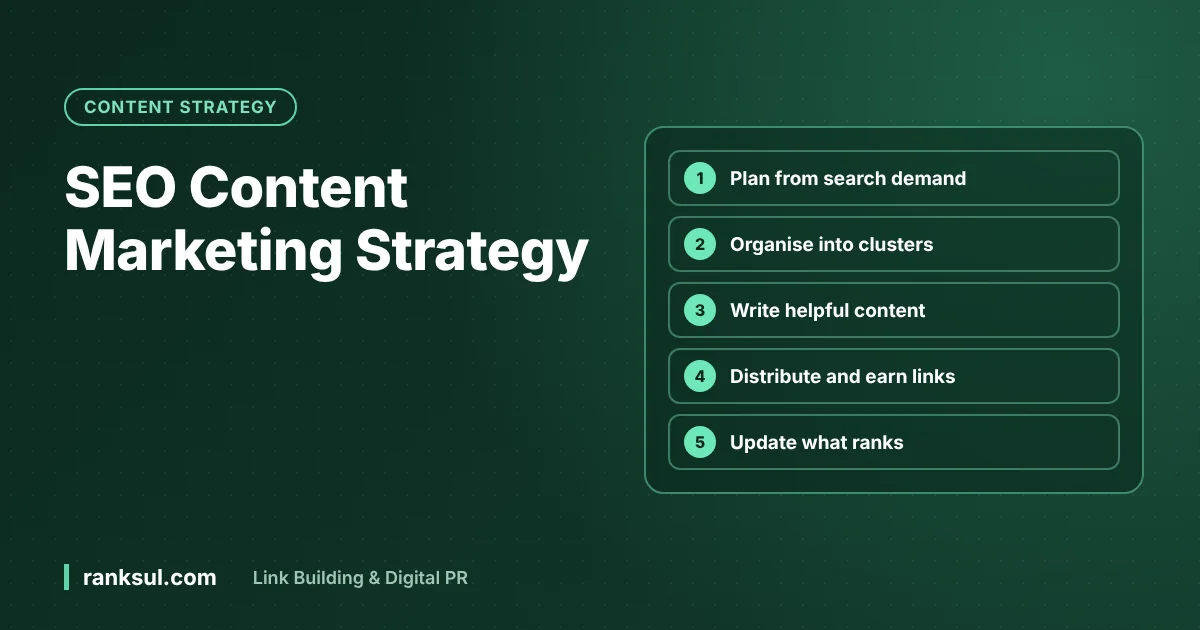
Plan from search demand
Begin with what your audience searches for and what your business sells. Use Google Search Console to see the queries you already appear for, and a research tool such as Ahrefs or Semrush to find related questions, keyword difficulty and the pages that rank today.
Prioritise topics where you can genuinely offer something better: more detail, first-hand experience, better examples or clearer steps. Our content strategy service turns this research into a plan.
Organise content into clusters
Group articles around core topics. Each cluster has a pillar page that covers the topic broadly and supporting articles that answer specific questions, all linking to each other. This structure helps search engines understand your expertise and helps readers find the next step. Our guide to topical authority architecture explains how to build one.
- One pillar page per core topic
- Five to fifteen supporting articles per pillar
- Links from every supporting article to the pillar and to related articles
- A clear next step to a service or product page
Write helpful content
Google's guidance on creating helpful, people-first content asks whether content shows first-hand expertise, answers the question fully and leaves the reader satisfied. Write for that standard: specific advice, real examples, accurate data and a clear structure with descriptive headings.
Ranksul's SEO content writing team writes articles this way, built around your focus keyword and your experts' knowledge.
Distribute and earn links
Publishing is the start, not the end. Share articles with your email list and social channels, and pitch your best resources to publications and newsletters in your industry. Links from relevant sites help your content rank and bring readers who are already interested.
Use guest posting on respected publications to point authority at your pillar pages, and browse publishers by topic in the marketplace.
Update what already ranks
Future-proof content by keeping it current. Each quarter, check which articles are losing impressions in Search Console, refresh their data and examples, improve answers to new questions, and update internal links. Updating a page that already ranks is often faster than writing a new one.
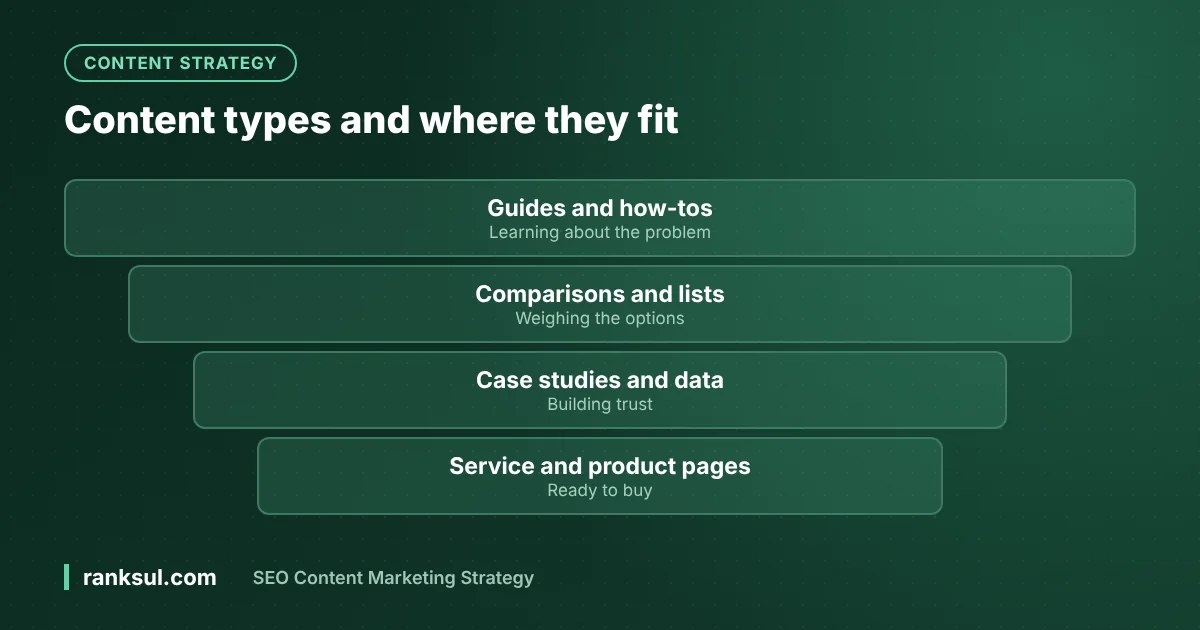
Content types and where they fit
- Awareness: guides, explainers, statistics pages, glossaries
- Consideration: comparisons, "best" lists, how-to-choose guides, case studies
- Decision: pricing, service and product pages, demos, alternatives pages
- Retention: help content, tutorials, templates
E-E-A-T in practice
Google's quality rater guidelines describe experience, expertise, authoritativeness and trustworthiness; "experience" was added in December 2022. Raters do not set rankings, but the guidelines describe what Google's systems aim to reward. In practice that means named authors with relevant backgrounds, first-hand details (your own data, photos, screenshots, results), sources for claims, an about page and clear contact information. Since March 2024, Google's helpful content signals are part of its core ranking systems rather than a separate update.
Writing a content brief that works
- Primary keyword and the search intent behind it
- The questions the top results answer, and the ones they miss
- The page on your site this article should link to
- Your unique angle: data, experience or examples only you have
- Outline with headings that answer one question each
- Sources to cite and experts to quote
Content decay and refreshes
Most articles lose traffic over time as competitors publish newer pages and facts go out of date. In Search Console, compare clicks for each page with the same period last year; pages with a large drop are candidates for a refresh. Update facts and examples, add what newer competitors cover, improve the answer at the top, and add internal links from newer pages. Change the date only when you have made real changes.
How to measure content marketing ROI
Track organic clicks and impressions per page, conversions and assisted conversions from organic landing pages, links and mentions each piece earns, and AI citations for your key topics. Group pages by cluster so you can see which topics pay back and where to invest next.
Distribution: how content earns links and visits
- Email it to your list and share it with customers it helps
- Post a summary or key chart on LinkedIn and relevant communities
- Pitch data and findings to journalists and newsletters
- Tell people you quoted or featured that it is live
- Link to it from related pages on your own site
- Use it in sales conversations and support answers
Using AI to write content: what works
Google's guidance focuses on whether content is helpful, not on how it was produced; it treats mass-produced content made mainly to manipulate rankings as spam ("scaled content abuse"). AI tools are useful for research, outlines and first drafts, but pages that rank and get cited add what AI cannot: first-hand experience, your own data, expert review and a clear point of view. Always fact-check figures and claims before publishing.
Keyword research for content, step by step
- List the problems your customers have before they buy
- Turn them into searches: questions, "how to", "best", "vs", "cost"
- Check search volume and difficulty in an SEO tool, and look at the current results
- Note the intent: do the results explain, compare or sell?
- Group close variants under one article; one intent, one page
- Score each topic by business value, demand and how winnable it is
SEO copywriting that ranks and converts
- Use the main keyword naturally in the title, H1, first paragraph and a subheading
- Answer the search question early, then go deeper
- Use short paragraphs, descriptive subheadings and lists for steps
- Add examples, numbers and screenshots from your own work
- Link to related articles and to the page that sells
- End each article with a clear next step for the reader
Building a content calendar that compounds
Plan by cluster, not by date. Each month, publish new pages for one cluster, refresh two or three pages that are losing traffic, and promote one piece that can earn links. A steady pace you can maintain beats bursts of publishing followed by silence, and refreshes often deliver results faster than new articles.
Putting SEO content marketing into practice
An SEO content marketing strategy needs two things most teams lack: a topic plan and the capacity to write. Our content strategy service builds the topic clusters, and our SEO content writing services produce the articles and pages, written by SEO content writers with knowledge of your subject.
SEO vs content marketing: what is the difference?
SEO is the practice of making a site visible in search: technical health, keyword targeting, on-page optimisation and links. Content marketing is the practice of creating and distributing useful material to attract and keep customers, through search, email, social and sales. They overlap in the middle: content written for searches people actually make.
- Goal: SEO, visibility in search; content marketing, attention and trust across channels
- Starts from: SEO, search demand; content marketing, audience needs and stories
- Measured by: SEO, rankings and organic traffic; content marketing, engagement, leads and revenue
- Works best: together, with one plan for both
A content marketing and SEO workflow, step by step
One process for both teams, from idea to results.
- Research: list the searches your buyers make, by funnel stage
- Prioritise: pick topics by business value, demand and how winnable they are
- Brief: set the intent, outline, sources, internal links and the page to link to
- Write: answer the question early, add first-hand detail, cite sources
- Optimise: title, headings, internal links and structured data
- Publish and promote: email, social and outreach to earn links
- Measure and refresh: review clicks and conversions each quarter and update what slips
Frequently asked questions
How long should SEO articles be?
As long as it takes to answer the question well. Many competitive topics need 1,500 words or more, but length without substance does not help.
How often should we publish?
Consistency matters more than frequency. Two excellent, well-promoted articles a month beat ten thin ones.
Can AI write our content?
AI can help with research and drafts, but readers and search engines reward first-hand expertise and accuracy, so every article needs real knowledge and careful editing.
Is SEO part of content marketing?
They overlap. SEO decides what people search for and how pages are found; content marketing creates and distributes the material. The best results come from planning them together.
How long does SEO content take to rank?
New articles on established sites often settle within weeks to a few months; on new or low-authority sites it can take longer, and competitive topics need links too.
How do SEO and content marketing work together?
SEO identifies what people search for and makes pages findable; content marketing creates and distributes the pages that answer those searches. Planned together, every article targets real demand and every SEO effort has something worth ranking.
What is the difference between SEO and content marketing?
SEO focuses on visibility in search engines: technical health, keywords and links. Content marketing focuses on creating and distributing useful material across all channels. They overlap in search-led content.
Want Ranksul (ranksul.com) to execute this strategy for your domain?
Book a complimentary strategy call. We will audit your current topical authority, editorial backlinks, and content clusters.