How to Evaluate a Guest Post Site: A 15-Point Checklist Before You Buy a Link
Buying links can be risky if you don't vet sites properly. Learn how to identify high-quality guest post opportunities that will genuinely boost your SEO.

Ranksul Team
SEO Strategist
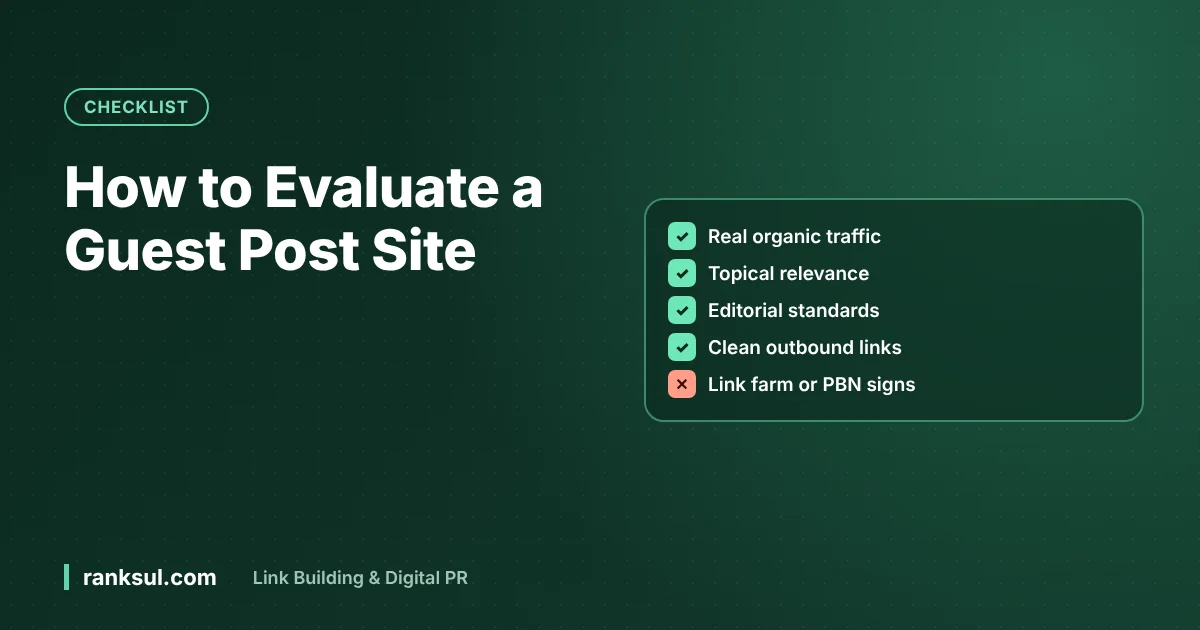
Introduction: Why Due Diligence is Non-Negotiable
Guest posting remains a powerful strategy in an editorial link building campaign, offering a dual benefit: referral traffic and valuable backlinks. However, not all guest post opportunities are created equal.
Acquiring links from low-quality or spammy websites can do more harm than good, potentially leading to Google penalties and a damaged reputation.
The key to successful guest posting isn't just getting a link; it's securing a link from a genuinely authoritative, relevant and high-quality source. That requires a careful evaluation process: a due diligence checklist that goes far beyond surface-level metrics.
Beyond Surface Metrics: Real Organic Traffic is King
Many link builders fixate on domain authority (DA), domain rating (DR), or similar proprietary metrics. While these can offer a quick glimpse, they are easily manipulated and don't tell the full story.
What truly matters is real organic traffic: actual human visitors coming from search engines. A site with high DA but no organic traffic is likely worthless for SEO.
To check a site's organic traffic, use reputable SEO tools like Ahrefs, Semrush or Moz. Look at the estimated monthly organic traffic, focusing on consistency and quality.
A steady stream of organic visitors each month, ranking for a diverse set of keywords relevant to its niche, indicates genuine content quality. Also make sure the traffic comes from countries relevant to your target audience.
A high DA/DR with negligible organic traffic (for example, fewer than 1,000 visitors a month for a general niche site), or traffic mainly from irrelevant countries, is a significant red flag.
- Does the site have a consistent trend of real organic traffic (e.g., 5,000+ monthly visitors for a niche site)?
- Is the organic traffic trend stable or growing, not declining?
- Does the site rank for a diverse set of relevant organic keywords?
- Is the organic traffic primarily from your target geographic regions?
Topical Relevance: The Contextual Connection
Google's algorithms are incredibly sophisticated at understanding context. A link from a highly authoritative site about pet grooming won't benefit your B2B SaaS website as much as a link from a moderately authoritative site about business technology. Relevance signals to Google that your link is a natural endorsement, not an artificial placement.
Browse the website yourself to assess its topical alignment. Does its main content match your niche or a closely related sub-niche? Check recent posts, categories, tags and the main menu for a clear, consistent focus.
Would the site's typical reader genuinely be interested in your content or service? A site that covers a broad range of unrelated topics (for example "tech, fashion, finance, cooking") with no clear theme is often a content farm and should be avoided.
- Is the site's core content directly relevant to your niche or a closely related industry?
- Are the most recent articles published on topics relevant to your business?
- Does the site's audience profile align with your target audience?
- Does the site maintain a clear, consistent topical focus across its categories and content?
Upholding Quality: Editorial Standards & User Experience
A high-quality website prioritizes its readers, which translates to well-written, accurate, and engaging content presented professionally. Google rewards sites that offer a good user experience.
Read several articles, navigate the site and test it on a phone. Look for clear, well-researched writing free of errors. Is the content genuinely helpful, or keyword-stuffed fluff? Are claims backed by evidence or linked to reputable sources?
Assess the design: is it easy to navigate, and does it load quickly? Ads are common, but excessive, intrusive ads hurt the user experience and signal a low-quality site. Check author profiles too: are they credible, or generic names with no detail?
Numerous grammatical errors, thin content (such as 300-word articles on complex topics), broken links, outdated design or overwhelming pop-ups are all red flags.
- Is the content well-written, grammatically correct, and free of typos?
- Is the content insightful, well-researched, and genuinely helpful to its audience?
- Is the website design professional, user-friendly, and mobile-responsive?
- Is the ad density reasonable and non-intrusive to the user experience?
- Do author profiles appear credible and well-developed?
Outbound Link Patterns: Where Do They Lead?
The company a site keeps through its outbound links speaks volumes. A reputable site will link naturally to other high-quality, relevant resources to enhance its content. A questionable site might link indiscriminately or exclusively to other low-quality sites.
Inspect the links inside articles with a browser extension or developer tools, and use SEO tools to review the site's overall outbound link profile. Do the links point to authoritative, relevant sources such as research, established news outlets and reputable industry blogs?
Are the anchor texts natural and varied, or over-optimized with exact-match keywords? There is no magic number, but an article with an excessive number of outbound links (for example 20+ in 1,000 words) can be a sign of a link farm.
Check whether the site uses `nofollow` or `sponsored` for paid and affiliate links, which shows it follows Google's guidelines. A site that links mainly to irrelevant, low-quality or spammy websites, or uses aggressive keyword-rich anchors, is a major red flag.
- Do the outbound links point to high-quality, relevant, and authoritative websites?
- Is the anchor text for outbound links natural and varied, not overly optimized?
- Is the number of outbound links per article reasonable and contextually justified?
- Does the site use `nofollow`/`sponsored` attributes appropriately for non-editorial links?
Red Flags: Spotting Link Farms and PBNs
Private Blog Networks (PBNs) and link farms are designed to manipulate search rankings. Google actively penalizes sites involved in such schemes. Identifying these red flags is paramount to protecting your own SEO.
Combine manual review with SEO tools. Look for generic, thin or spun content that sounds machine-generated or lacks depth. Excessive, irrelevant ads and no sign of engagement (comments, shares) suggest there is no real audience.
Check the site's own backlink profile in a tool like Ahrefs: many links from other low-quality sites, or a sudden unnatural spike in backlinks, are suspicious. Moz's Spam Score is a quick indicator, though not definitive on its own; a score of 7+ is usually concerning.
PBN sites often have generic, outdated or poorly maintained designs. Look at Whois history for frequent ownership changes or domains previously used for other niches. When one vendor offers several sites, check for identical themes, plugins or hosting, a common PBN trait.
Finally, a site whose traffic suddenly dropped to near zero is a huge red flag, often a sign of a Google penalty. Any combination of these signs, or a site that simply feels "off", usually means you should walk away.
- Does the content appear generic, thin, or potentially AI-generated/spun?
- Is the site overwhelmed with excessive, intrusive, or irrelevant advertisements?
- Is there a clear lack of user engagement (comments, social shares)?
- Does the site's own backlink profile appear suspicious or unnatural?
- Does the site have a high Moz Spam Score (e.g., 7+)?
- Does the website design look generic, outdated, or poorly maintained?
- Is there evidence of sudden, unexplained drops in organic traffic?
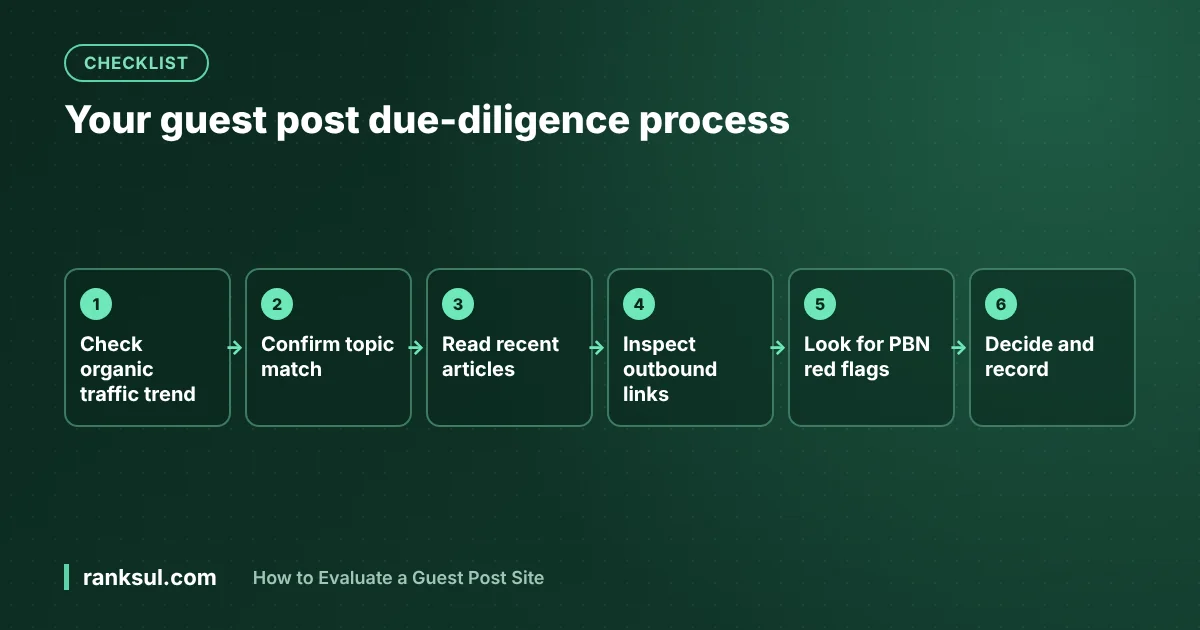
Putting It All Together: Your Due Diligence Process
Evaluating a guest post site isn't about ticking off a few boxes; it's about forming a complete picture of its quality and relevance. No single metric or red flag should decide on its own.
A site might have slightly more ads but make up for it with excellent content and strong organic traffic. A site with a decent DA but no organic traffic and irrelevant outbound links, on the other hand, is a definite pass.
Develop a scoring system based on these criteria. Weight what matters most to your campaign (relevance may matter more than a perfect UX for some niche sites), and always pair a manual review with your tool-based analysis.
The goal is to earn links that genuinely strengthen your site's authority and visibility, not just to add to a count.
The 15-point guest post site checklist
Score each point 0 (fails), 1 (partly) or 2 (passes). Sites scoring 22 or more out of 30 are usually worth it; under 15, walk away.
- Organic traffic is real and stable or growing over 12 months
- Most traffic comes from the country or language you target
- The site ranks for keywords related to your topic
- Recent articles are relevant to the page you want to link
- Articles have named authors and an editorial voice
- The site has an about page, contact details and a clear owner
- Recent posts are indexed (search site:domain.com + title)
- Outbound links in recent posts are mostly editorial, not commercial
- The site does not publish on every topic (casino, crypto, pets and roofing together)
- The live sample article is well written and read like the rest of the site
- The link type (do-follow, no-follow, sponsored) is stated before you buy
- The price fits the site's traffic and authority compared with similar sites
- The site loads properly and works on mobile
- DR and DA are reasonable for the traffic (no big gap between score and readership)
- There is a policy for removed or changed links
Tools for checking a guest post site
- Ahrefs, Semrush or Similarweb: organic traffic, its trend and top countries
- Google search (site:domain.com): indexing and what the site publishes
- archive.org: whether the domain changed owner or topic
- Moz and Ahrefs free checkers: DA and DR
- A marketplace that shows metrics, link type and samples for each site
Worked example: scoring two sites
Imagine a fitness blog with steady 40,000 monthly visits from the US, named trainers as authors, posts mostly linking to studies and gear reviews, and a clear sponsored-post policy. It scores high on almost every point.
Compare a "general news" site with DR 70 but 1,200 visits, posts on every topic and casino links in recent articles. Despite the higher DR, it fails on traffic, relevance and outbound links, and would score under 15.
Conclusion
In the competitive landscape of SEO, the quality of your backlinks can make or break your rankings. Taking the time to evaluate potential guest post sites is a critical step in a responsible link building strategy.
Focus on real organic traffic, strict topical relevance, high editorial standards and natural outbound links, and avoid link farm red flags. Your guest posts will then deliver positive, sustainable SEO results. Choose wisely, and build your authority one valuable link at a time.
Frequently asked questions
What is the most important factor when evaluating a guest post site?
Real organic traffic from your target audience, combined with topical relevance. A high DR without readers is the most common trap.
How can I tell if a guest post site is a link farm?
Look for sites that publish on every topic, link out to commercial sites in almost every post, have little organic traffic despite a high DR, and have no real authors or contact details.
Should I avoid sites that label posts as sponsored?
No. Labelling is honest and often required. Sponsored links pass less ranking value, so weigh the price and the brand exposure accordingly.
How do I vet a guest post marketplace for quality and reliability?
Check five things. Does it show each domain before you pay? Are its traffic figures from a named source you can check? Does each site have a live sample article? Do you pay only after the placement is confirmed, with a written replacement policy? And do real customers review it on sites the marketplace does not control?
Then buy one or two links and check them with the 15-point checklist above before ordering more.
Want Ranksul (ranksul.com) to execute this strategy for your domain?
Book a complimentary strategy call. We will audit your current topical authority, editorial backlinks, and content clusters.