What Is a Backlink? Types of Backlinks and Which Ones Help SEO
A plain-English explanation of backlinks: what they are, why Google counts them, the different link types, what makes one valuable or harmful, and how to see which sites link to you.

Ranksul Team
SEO & Link Building Team
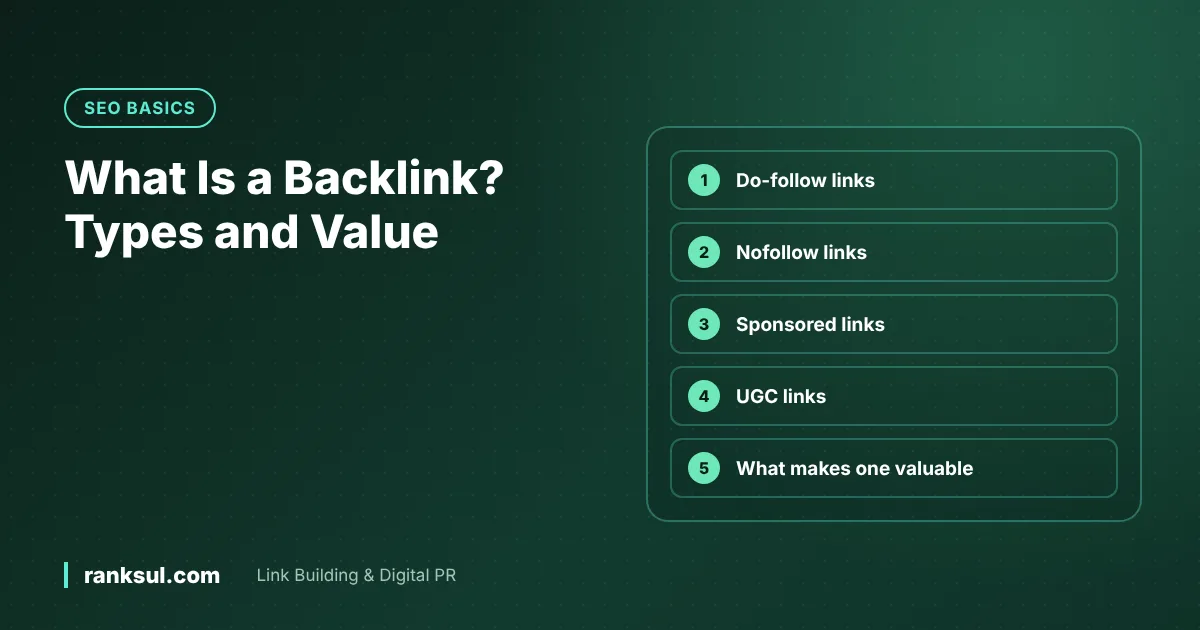
What is a backlink?
A backlink (also called an inbound link or incoming link) is a link on another website that points to a page on yours. If a food magazine writes about your kitchen knives and links to your shop, that link is a backlink to your shop.
Links within your own website are internal links. Backlinks always come from a different domain.
Why backlinks matter for SEO
Google was built on the idea that links work like citations: if many respected pages link to a page, it is probably useful. Its systems have grown far more complex since, but links remain one of the strongest signals it uses to judge which pages deserve to rank.
Backlinks also help Google discover your pages, send you visitors directly, and shape what AI answers in Google, ChatGPT and Perplexity say about your brand, because those systems lean on what credible sites write. Our generative engine optimization guide explains that side.
Types of backlinks
Every link can carry a rel attribute that tells search engines how to treat it. These are the main types:
Do-follow links
A normal link with no special attribute. It can pass ranking value to the page it points to. Most links in editorial articles are do-follow. In the Ranksul marketplace, 92% of publishers offer do-follow placements; each publisher sets its own link type, and it is shown before you buy.
Nofollow links
Marked rel="nofollow". Google treats it as a hint rather than a strict rule, so it may or may not count. Nofollow links still bring visitors and brand awareness, and a natural link profile always includes some.
Sponsored links
Marked rel="sponsored". Google asks sites to use this for links that were paid for, such as advertising and sponsored articles. It keeps paid placements inside the rules.
UGC links
Marked rel="ugc", for user-generated content such as comments and forum posts. Like nofollow, they carry little ranking value.
Backlinks by how you get them
Links are also described by where they come from. These are the ones you will see most often:
- Editorial links: an author links to you because your page helps their readers. The most valuable kind
- Guest post links: a link inside an article you wrote for another site. See our guest posting services
- Niche edits: a link added to an article that is already published. See niche edits
- Digital PR links: coverage on news sites from a story or data you put out. See digital PR services
- Profile and directory links: business listings, review sites and associations
- Press release links: syndicated news releases, mostly useful for visibility rather than rankings
What makes a backlink valuable
Two links can look the same and be worth very different amounts. These are the factors that matter most:
- Relevance: the linking site and page are about your topic
- Real traffic: the site gets visitors from Google, which shows Google trusts it
- Placement: the link sits in the main text of an article, not a footer, sidebar or author box
- Anchor text: describes the page naturally, without repeating the same exact keyword everywhere
- Authority: the site itself has links from other respected sites
- Uniqueness: a link from a new website usually counts for more than a tenth link from the same one
DR, DA and why scores are not enough
Domain Rating (Ahrefs) and Domain Authority (Moz) estimate how strong a site's backlink profile is. Google does not use them. They are useful for quick comparisons, but they can be inflated, and they say nothing about whether a site has readers.
Our own data shows why you should look further: a typical DR 50 to 69 site in our marketplace costs $80 per placement, while a DR 70 to 79 site costs $210, and DR alone says nothing about whether a site has readers. Our DR vs DA guide explains how to use both.
Bad backlinks and when to worry
Every site picks up some spammy links over time, and Google ignores most of them. You only need to act if you or someone you hired built manipulative links at scale, or if Search Console shows a manual action.
Warning signs include links from link networks, hacked sites, pages full of unrelated outbound links, and large numbers of links with the same exact-match anchor. If you have a manual action, remove what you can and use Google's disavow tool for the rest.
How to check your backlinks
Google Search Console is free and shows the sites linking to you under Links. It is the best view of what Google itself has found, though it does not show every link.
Ahrefs, Semrush and Moz crawl the web independently and show more detail: when each link was found, its anchor text, whether it is do-follow, and the strength of the linking site. Checking a competitor's backlinks in the same tools is one of the quickest ways to find sites worth approaching.
How to get backlinks
The best links are earned with content worth citing, but there are many practical ways to get them, from business profiles and unlinked mentions to guest posts and digital PR. Our guide on how to get backlinks ranks 17 methods by effort and impact.
If you prefer to choose placements yourself, the Ranksul marketplace lists publishers with their DR, DA, organic traffic, link type and price, with sample articles you can open before you order.
Frequently asked questions
Are backlinks still important in 2027?
Yes. Google has said links matter less than they once did as a share of its signals, but they remain an important way it judges trust, and pages that rank for competitive searches almost always have links from other sites.
What is the difference between a backlink and an internal link?
A backlink comes from another website. An internal link points from one page of your site to another. Both help Google understand your pages, but only backlinks show that other sites vouch for you.
Do nofollow links help SEO?
Sometimes. Google treats nofollow as a hint and may count some of these links. They also bring visitors and make your link profile look natural.
How much does a backlink cost?
In the Ranksul marketplace the typical placement costs $80, and half of all publishers charge between $43 and $215. The full breakdown by DR, niche and country is in our Link Building Price Index.
Want Ranksul (ranksul.com) to execute this strategy for your domain?
Book a complimentary strategy call. We will audit your current topical authority, editorial backlinks, and content clusters.