Link Building Strategy for 2027: A 7-Step Blueprint for Safe DR 70+ Editorial Links
Strong links from DR 70+ publications can transform rankings, if they are relevant and earned safely. Here is a complete blueprint, from audit to reporting.

Ranksul Team
SEO & Link Building Team
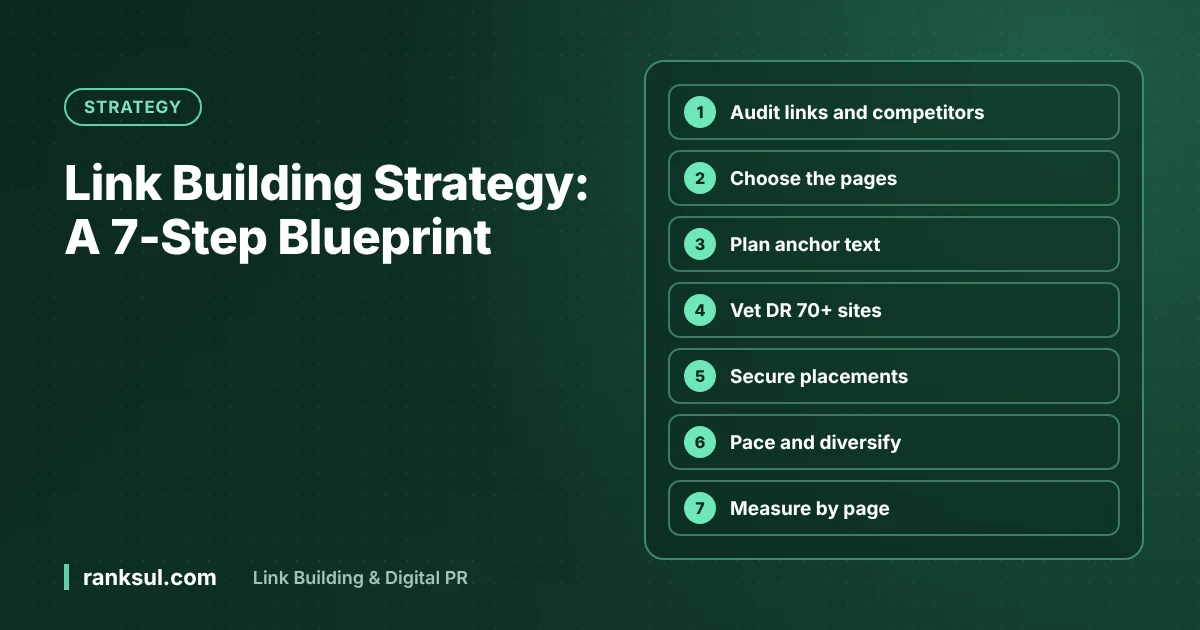
Step 1: audit your links and competitors
Export your backlinks from Ahrefs or Semrush and check the Links report in Google Search Console. Then compare your referring domains with the sites ranking above you for your main keywords. The gap shows how many and what kind of links you need.
Step 2: choose the pages that need links
Links work best when they point at pages that can rank and convert: service pages, category pages and strong guides. List your priority pages, the keywords each targets and their current positions. Pages on page two of results are often the quickest wins.
Step 3: plan anchor text
A natural profile uses mostly brand names, URLs and descriptive phrases, with a small share of exact keywords. Overusing exact-match anchors is a classic sign of manipulation. Plan anchors per page before you order a single placement.
- Brand anchors: "Ranksul", "ranksul.com"
- Descriptive anchors: "this guide to guest posting"
- Partial-match anchors: "editorial link building services"
- A small share of exact keywords on the most relevant placements
Step 4: find and vet DR 70+ publications
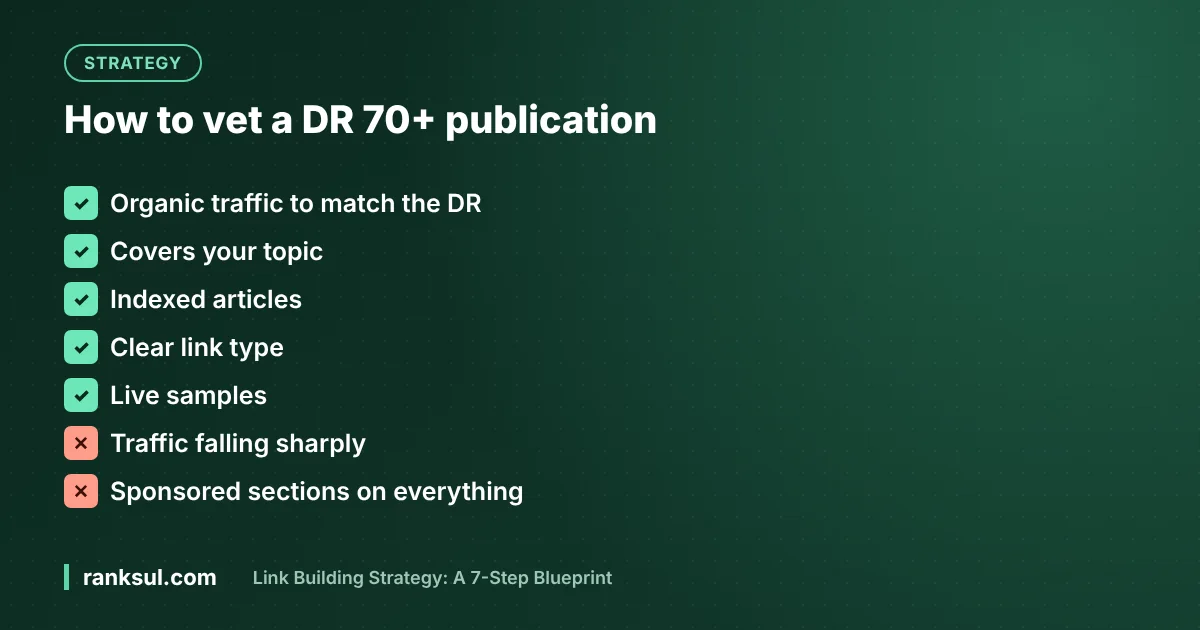
High-authority publications pass strong signals, but only real ones. For each site, confirm organic traffic and its trend, relevance to your topic, editorial standards and the link type offered. Our guide to choosing DA and DR metrics covers the checks in detail.
The Ranksul marketplace shows DA, DR, traffic, link type and often a live sample for each publisher, and our high DA backlinks service focuses on DR 70+ sites with real audiences.
Step 5: secure the placements
Use three routes together. Order placements on publications that accept contributed articles through guest posting. Pitch editors at sites that do not sell placements through manual outreach. And earn coverage with digital PR when you have news or data.
Every article should be genuinely useful to the publication's readers, with your link where it helps them. Follow Google's spam policies and the publisher's disclosure rules.
Step 6: pace and diversify
Build links steadily rather than in sudden bursts, and mix authority levels, link types and countries. A few No-Follow links from major publications are normal and bring visibility; most of your authority will come from relevant Do-Follow backlinks.
Step 7: measure by page
Track each target page: referring domains gained, rankings for its keywords, organic clicks in Search Console and conversions in analytics. Review quarterly and move budget to the pages and link types that work. Ranksul reports every live link and backs placements with a 1-year replacement warranty.
What a link building strategy is (and what it is not)
A link building strategy is a plan for which pages on your site need links, how many, from what kind of websites, with what anchor text, and how fast. Tactics such as guest posts, digital PR or broken-link outreach are the tools you use to carry out that plan. Many guides list tactics; few help you decide which ones you need. The steps above are the decision part. This section covers the tactics and the mistakes that cost the most.
Links still matter because Google uses them to discover pages and to judge how trusted and relevant a page is. Google's own documentation describes links as a signal used to understand relevance, and its spam policies describe the link practices it treats as manipulation. A good strategy lives between those two facts: earn and place links that a real editor and a real reader would recognise as useful.
The link building tactics that still work in 2027
No single tactic is enough. Strong link profiles combine several, because each one reaches a different kind of site.
Editorial placements on relevant publications
Articles written for real publications, with a contextual link to your page. Fast and predictable, and the main tool for specific target pages. The risk is choosing sites that sell links to anyone: vet traffic, topic and outbound links. See what placements cost in our Link Building Price Index.
Digital PR with data or news
Stories journalists choose to cover: original data, expert comment, launches. Slower and less predictable, but the links are fully editorial and often from the strongest sites in a market. Read our digital PR campaign guide.
Linkable assets
Something on your own site that others want to cite: a statistics page, a calculator, a template, an index or a definitive guide. Assets turn every other tactic into an easier pitch, because you are offering something useful rather than asking for a favour.
Resource pages and broken-link outreach
Many sites keep lists of useful resources, and many of those lists link to pages that no longer exist. Offering your page as a working replacement is one of the few outreach pitches that helps the editor directly.
Unlinked brand mentions
Sites that mention your brand or data without linking. A short, polite request to add a link converts well because the editor already chose to write about you.
Partners, suppliers, associations and local organisations
Real business relationships produce links competitors cannot copy: partner directories, case studies on a supplier's site, industry association member lists, event sponsorships and local community pages.
Tactics that put your rankings at risk
Some tactics still appear in older guides but carry real risk now that Google detects link spam with machine learning (SpamBrain) and can simply ignore or act on unnatural links.
- Private blog networks (PBNs): sites built only to sell links, often on expired domains
- Sitewide, footer and sidebar links sold as packages
- Large guest post campaigns with keyword-rich anchor text, which Google names in its spam policies
- Comment, forum and profile links created in bulk
- Low-quality directories and article directories
- Link exchanges at scale ("you link to me, I link to you")
Link building penalties and how to recover
There are two kinds of problem. A manual action is applied by a Google reviewer and appears in Search Console under Security and Manual actions, usually as "Unnatural links to your site". An algorithmic problem has no notice: Google's systems simply discount the links, so rankings stall or drop after an update.
For a manual action, find the unnatural links, ask site owners to remove them where you can, disavow the rest with Google's disavow tool, document what you did and file a reconsideration request. For algorithmic issues, the fix is to stop the risky activity and build genuinely editorial links; Google has said most sites never need to use the disavow tool.
What a natural link profile looks like
You do not need to fake randomness, but it helps to know what real profiles look like. Sites that earn links naturally have a mix of strong and modest sites, mostly branded and URL anchors, links to many pages (not only the home page), some no-follow links, and steady growth that follows their activity: launches, coverage, new content.
- Anchors: mostly brand, URL and natural phrases; few exact-match commercial keywords
- Authority: a few strong publications, many relevant mid-range sites
- Targets: home page, service pages, guides and data pages
- Link types: mainly do-follow, with some no-follow from big brands
- Pace: steady monthly growth rather than one burst
Example 6-month link building plan
A simple plan for a business with a few key commercial pages and a moderate budget. Adjust the numbers to the gap between you and the sites ranking above you.
- Month 1: audit links and competitors, pick 5 target pages, publish one linkable asset
- Month 2: 4–6 editorial placements on relevant mid-authority sites to the target pages
- Month 3: 1–2 DR 70+ placements to the most important page; start broken-link outreach
- Month 4: digital PR pitch around your data asset; claim unlinked mentions
- Month 5: repeat placements for pages that moved; add links to pages still on page 2
- Month 6: review rankings and traffic per page, and reset the plan
Worked example: planning links for one service page
Say you run an accounting firm and want "small business accountant Manchester" to rank. The page sits at position 14. The three pages above you have 40, 55 and 70 referring domains; your page has 6 and your site 30.
You do not need 60 new links. You need enough relevant ones to close the gap on the page and the site.
A sensible plan: 4 placements on UK business and finance sites linking to the service page with branded or descriptive anchors, 2 local links (a local business news story, a chamber of commerce profile), a guide on "tax deadlines for UK small businesses" that earns links over time and links to the service page, and internal links from your three most visited blog posts.
Review in 8 to 12 weeks; if the page reaches the top 5, shift to the next page on your list.
Tools for link building
- Link analysis: Ahrefs, Semrush, Majestic or Moz to see your links and competitors' links
- Free data: Google Search Console (Links report) and Bing Webmaster Tools (backlinks)
- Prospecting: Google search operators (intitle:"resources" + topic, "write for us" + topic)
- Outreach: a spreadsheet or CRM to track who you contacted and replies
- Monitoring: a link checker to confirm placements stay live and keep their attributes
- Prices and placements: a marketplace that shows metrics and samples before you buy
Link building glossary
Referring domain
A unique website linking to you. Ten links from one site count as one referring domain.
Anchor text
The clickable words of a link. It tells readers and search engines what the linked page is about.
Do-follow / no-follow / sponsored
A normal link passes ranking signals; links marked rel="nofollow", "sponsored" or "ugc" are hints that it should not.
Contextual link
A link inside the body of an article, surrounded by relevant text, as opposed to a footer, sidebar or profile link.
Link velocity
How fast a site gains links. Sudden spikes without a reason (news, a launch) can look unnatural.
Linkable asset
A page designed to earn links on its merits: data, tools, templates or definitive guides.
Planning a link building campaign
A link building campaign is the blueprint above applied to a fixed period, usually three to six months: a set of target pages, a number of placements per month, an anchor text plan and a review date. Advanced link building strategies such as data-led digital PR or linkable assets fit inside a campaign as one source of links among several, not as a replacement for editorial placements.
Frequently asked questions
How many DR 70+ links do I need?
It depends on your competitors. Compare referring domains with the pages that outrank you; often a handful of strong, relevant links makes a visible difference.
How fast will rankings move?
Usually within a few weeks to a few months after links are indexed, depending on competition and the rest of your SEO.
Is it safe to buy DR 70+ placements?
Placements on real, relevant publications with genuine audiences are a normal marketing practice. Avoid networks built only to sell links. Read manual outreach vs PBNs.
What is the best link building strategy for a new website?
Fix the basics first (indexable pages, useful content), then combine a linkable asset with a few relevant editorial placements and partner links. New sites benefit most from steady, relevant links to a small number of important pages.
How long does link building take to work?
Usually three to six months for noticeable movement, faster for pages already on page 2 and slower for very competitive keywords. Links need to be discovered, indexed and weighed alongside everything else on your site.
Is link building still worth it with AI search?
Yes. AI answers draw on pages that already rank and on brands mentioned across the web, so links and mentions support AI visibility as well as classic rankings.
What is the difference between link building and link earning?
Link earning means creating something people link to without being asked; link building includes the active work of outreach and placements. Most strategies need both.
Want Ranksul (ranksul.com) to execute this strategy for your domain?
Book a complimentary strategy call. We will audit your current topical authority, editorial backlinks, and content clusters.