Generative Engine Optimization (GEO): A Practical 2027 Guide for Brands
GEO is the practice of getting your brand mentioned and cited in AI-generated answers. Here is what it really involves, what Google says about it, and a plan you can start this week.

Ranksul Team
SEO & Link Building Team
What generative engine optimization means
Generative engine optimization (GEO) is the work of making your brand appear in answers written by AI systems: ChatGPT, Perplexity, Gemini, Claude and Google's AI Overviews and AI Mode. The term comes from a 2023 research paper, and the industry also uses AEO (answer engine optimization), LLMO and "AI SEO" for much the same thing; Wikipedia has a useful summary of the history.
Where classic SEO asks "do we rank?", GEO asks "when someone asks an AI assistant about our category, is our brand in the answer, and is our site one of the sources?". The two overlap far more than the new name suggests.
GEO is built on SEO, not instead of it
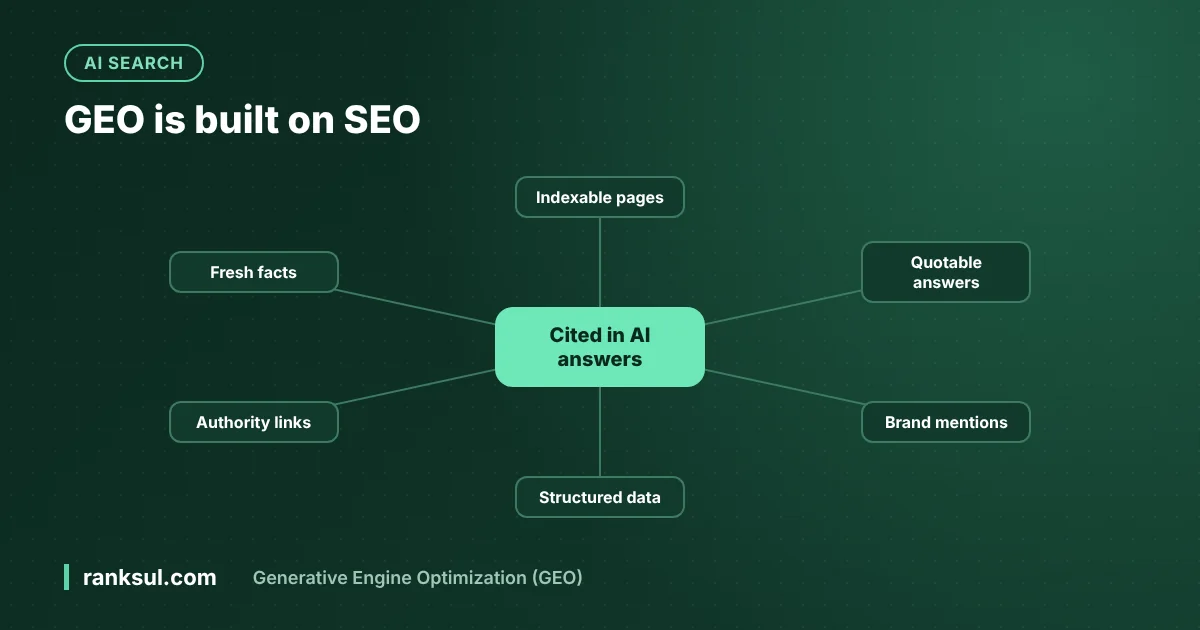
Google's own guidance on AI features and your website is clear: there are no special requirements for appearing in AI Overviews or AI Mode. Pages must be indexed and eligible for a snippet, and the usual advice about helpful, reliable content applies. Other assistants that search the web behave similarly: they lean on pages that already rank and on sources that look authoritative.
So the foundations stay the same: a crawlable site, content that answers real questions, and authority earned from other websites. Our technical SEO and content strategy services cover those foundations.
What AI answers tend to quote
AI systems assemble answers from passages they can lift cleanly. Content that gets cited usually shares a few traits:
- A direct answer in the first sentence under each question-style heading
- Specific facts, numbers, steps and named methods instead of general claims
- Tables for comparisons and numbered lists for processes
- Clear definitions of terms the reader might not know
- Up-to-date information with a visible date and author
Why brand mentions matter so much
When an assistant recommends a product or agency, it reflects what many sources say. Several 2026 studies by SEO vendors found that brands mentioned widely across the web appear more often in AI answers, sometimes more strongly than raw backlink counts would predict. These are correlations from vendor data rather than proof, but they match common sense: an AI answer repeats the consensus it finds.
That makes off-page work more important, not less. Coverage on respected publications through digital PR, placements on news sites and contextual editorial links all add to how often your brand appears in the sources AI systems read. You can browse publications by topic in the Ranksul marketplace, for example technology or business and finance sites.
A 30-day GEO plan
Week 1: baseline
Write down 20 to 30 prompts your customers would ask an assistant, from "what is…" questions to "best agency for…". Run them in ChatGPT, Perplexity and Google, and note whether your brand or site appears. Check indexing and impressions in Google Search Console.
Week 2: fix your best pages
Pick the ten pages that answer the most valuable prompts. Rewrite their openings to answer directly, add a short FAQ, add structured data where it fits, and make sure the main content is in the HTML, not loaded late by scripts.
Week 3: earn mentions
Place two or three articles or expert comments on publications your customers read, linking to the pages you improved. Our guide to the modern link building blueprint explains how to choose them.
Week 4: measure and repeat
Run the same prompts again and compare. AI answers vary from run to run, so look at the trend over months rather than a single check. Our article on AI SEO and LLM visibility tools compares tools that automate this tracking.
Common GEO mistakes
- Publishing large amounts of thin AI-written content: Google's spam policies on scaled content abuse apply
- Blocking the crawlers you want to be cited by in robots.txt
- Chasing one assistant's quirks instead of building authority everywhere
- Judging results from a single prompt run
Where the term "GEO" comes from
Generative engine optimization was named in a November 2023 research paper by Pranjal Aggarwal and colleagues ("GEO: Generative Engine Optimization"). The researchers tested how changes to a page affected whether generative search engines cited it, and found that adding citations to sources, quotations from experts and specific statistics improved visibility in AI responses by up to about 40% in their tests, while keyword stuffing did not help.
The paper is useful less for its exact numbers than for its direction: AI answer engines reward content that is easy to verify and quote. That lines up with what SEO already rewards, which is why GEO builds on SEO rather than replacing it.
How the main AI engines find sources
The engines work differently, which is why visibility can differ between them.
Google AI Overviews and AI Mode
Built on Google's search index. Google says pages need to be indexed and eligible to appear with a snippet, and that normal SEO best practices apply; there is no separate markup to qualify. AI Mode may run several related searches ("query fan-out") and cite pages from each.
ChatGPT search
Uses web search results from search partners and its own crawler (OAI-SearchBot) to fetch pages, then cites them. Pages blocked to its crawler are less likely to be used.
Perplexity
Runs its own retrieval with PerplexityBot and shows citations prominently, which makes it easy to see which pages it relies on for a topic.
Microsoft Copilot
Grounded in Bing's index, so Bing indexing (and Bing Webmaster Tools) matters for Copilot visibility.
Gemini app and Claude
Can use web search when a question needs current information; otherwise they answer from training data, where brand mentions across the web shape what the model knows about you.
LLM optimization techniques, ranked by effort and impact
- Low effort, high impact: answer the main question in the first two sentences of each section
- Low effort: add specific numbers, dates and named sources to key claims
- Low effort: make sure AI and search crawlers are allowed in robots.txt
- Medium effort: add short definitions, comparison tables and step lists that can be quoted
- Medium effort: keep facts about your company consistent on your site, profiles and directories
- High effort, highest impact: earn mentions and links on publications AI engines already cite
- High effort: publish original data others will reference
How to structure content for LLMs
AI engines pull passages, not whole pages. Each section should make sense when it is quoted on its own.
- One question per heading, written the way people ask it ("How much does link building cost?")
- The answer in the first one or two sentences under the heading, then the detail
- Short paragraphs that name the subject instead of relying on "it" or "this" from earlier sections
- Definitions, comparison tables and numbered steps, which are easy to lift into an answer
- Specific facts with a date and a named source, and quotes from named experts
- Key content in the HTML, not loaded only by JavaScript or hidden in images
llms.txt for your website: does Google use it?
llms.txt is a plain-text Markdown file at the root of a website (yoursite.com/llms.txt) that summarises the site for language models and links to its most useful pages. It was proposed in September 2024 by Jeremy Howard of Answer.AI, so that AI tools could read a short, clean overview instead of crawling cluttered pages.
Google does not use it. Google's Gary Illyes said in 2025 that Google does not support llms.txt and has no plans to, and John Mueller has compared it to the old keywords meta tag. No other major AI search engine has confirmed it uses the file for ranking or citation either. So llms.txt is not an SEO factor: it will not move your Google rankings or AI Overview citations.
It is still cheap to add and can help AI coding and research tools that do read it. Keep it short: one line saying what the business is, then links to your key pages with a sentence each. Ranksul publishes one at ranksul.com/llms.txt. Then spend your real effort on clear pages and mentions on other sites, which every AI engine does use.
How to measure GEO
Write 20 to 50 prompts your customers would ask ("best X for Y", "how much does X cost", "X vs Y"), run them monthly in ChatGPT, Perplexity, Gemini and Google, and record whether you are mentioned, whether you are cited with a link, and which sources are cited instead. Dedicated AI visibility tools automate this; a spreadsheet works to start. Pair it with referral traffic from AI domains in your analytics. See our guide to LLM visibility tools.
GEO vs SEO: what changes and what does not
Stays the same
Crawlable, indexable pages; helpful content written for people; authority from links and mentions; clear site structure; accurate facts.
Matters more
Direct answers in the first sentences of a section; specific numbers and named sources; consistency of facts about your brand across the web; mentions on sites AI tools cite; being the clearest page for narrow sub-questions.
Matters less
Exact keyword repetition; ranking for a single head term as the only goal; click-through rate tricks in titles that do not reflect the content.
Example: rewriting a section for GEO
Before: "Link building has changed a lot over the years, and many factors influence what it costs. In this section we will look at some of them."
After: "A placement on the Ranksul marketplace costs a median of $80 including the article. Prices rise with authority: DR 70+ publications typically cost several hundred dollars or more, while small niche sites can cost under $50."
The second version answers the question, gives numbers and names the source. It is easier for a reader to use and for an AI system to quote.
GEO checklist for every important page
- The page answers its main question in the first two sentences
- Each section heading is a question or a clear topic, answered right below it
- Key claims have numbers, dates and sources
- The author and the organisation behind the page are clear
- Structured data matches the visible content
- The page is linked from related pages on your site
- The facts match what your profiles and directories say
Frequently asked questions
Is GEO different from SEO?
It has a different goal (being cited in answers rather than only ranking), but it relies on the same foundations: indexable pages, helpful content and authority. Google describes optimising for its AI features as SEO.
Do I need a separate GEO agency?
Not usually. Look for an SEO partner that builds real authority (editorial placements, digital PR) and tracks AI visibility. Ranksul's SEO services include both.
How long does GEO take?
Page improvements can show in AI answers within weeks once pages are recrawled; brand authority builds over months. Start with a free SEO audit to find the quickest wins.
Is GEO the same as AEO?
Mostly. Answer engine optimization (AEO) is an older term for getting content into direct answers and featured snippets; GEO covers AI-generated answers. The techniques overlap heavily.
What are the best LLM optimization techniques?
Answer each question in the first sentences of a section, add specific facts, statistics and quotes from named experts, keep your brand facts consistent everywhere, allow AI crawlers in robots.txt and, most important, earn mentions on the publications AI engines already cite for your topic.
Is llms.txt good for SEO?
No. Google has said it does not use llms.txt, and it has no effect on rankings. It is a harmless, optional summary for AI tools that choose to read it.
Can I pay to be included in AI answers?
Not in organic AI answers. Some platforms are testing ads near AI answers, but citations themselves are not sold.
Does GEO work for small businesses?
Yes, especially for specific and local questions, where fewer sources compete. Clear service pages, consistent business details and local coverage all help.
What are the core ranking factors in generative engine optimization?
No AI search engine publishes a list of ranking factors. What AI answers tend to quote is consistent, though: pages that already rank well in normal search, a clear answer near the top of the page, facts with a date and a source, and brands that other trusted sites mention.
The crawlers AI search uses (Googlebot, Bingbot, OAI-SearchBot, PerplexityBot) must not be blocked in robots.txt, and the answer must be in the page text, not only in an image or a script.
Want Ranksul (ranksul.com) to execute this strategy for your domain?
Book a complimentary strategy call. We will audit your current topical authority, editorial backlinks, and content clusters.