LLM Visibility in 2027: How to Audit, Track and Improve Your Brand in ChatGPT and AI Search
LLM visibility is how often AI assistants mention and cite your brand. Here is how LLMs see brands, how to audit and track your visibility, and what gets a brand cited.

Ranksul Team
SEO & Link Building Team
What LLM visibility means
LLM visibility is how often, and how accurately, large language models and AI assistants mention your brand and cite your website when people ask about your topic. It covers ChatGPT, Gemini, Claude, Copilot and Perplexity, and the AI Overviews and AI Mode answers in Google Search.
It has two parts. A mention is your brand named in the answer; a citation is a link to one of your pages as a source. Mentions shape what buyers think of you, citations send visits. Both depend on the same things: pages that answer questions clearly, and trusted websites that talk about you.
How AI search chooses its sources
AI search products such as Google AI Overviews, ChatGPT search, Perplexity and Gemini write an answer and then show the pages they drew from. To do that, they retrieve pages from a search index, so the pages that rank well and are easy to understand are also the pages most likely to be cited.
Google states in its documentation on AI features and your website that there are no additional requirements to appear in AI Overviews: a page must be indexed and eligible to show with a snippet. In other words, AI SEO starts with ordinary SEO done well.
What LLM visibility tools measure
LLM visibility tools run a list of prompts that your customers might ask, such as "best link building service for SaaS", through one or more AI assistants and record whether your brand is mentioned, whether your site is cited, and which competitors appear instead. Repeated over time, this shows whether your share of AI answers is growing.
Because AI answers vary between runs, locations and accounts, treat these numbers as a trend line rather than a precise ranking. Several established SEO suites, including Semrush and Ahrefs, now offer AI visibility reports alongside their classic rank tracking, and there are dedicated tools built only for this purpose.
- Prompts grouped by topic and buying stage
- Brand mentions and citations per assistant
- Competitors cited for the same prompts
- Which of your pages are cited, so you know what to strengthen
- History, so you can see the effect of new content and links
Make your pages easy to quote
AI systems favour pages that answer a question directly. Put a clear one or two sentence answer near the top of each page, then explain the detail. Use descriptive headings, short paragraphs, tables for comparisons and lists for steps. Add structured data where it describes the page accurately, such as Organization, Product or FAQ markup.
Facts beat fluff. Specific numbers you can stand behind, named methods and original data give an AI answer something worth citing. Our SEO content writing team writes pages this way, and our AI search playbook covers the structure in more detail.
Why mentions on other sites matter more than ever
An assistant deciding which brands to recommend looks at what the web says about them. Mentions and links on respected news sites, industry publications and review sites tell both search engines and language models that your brand is credible in a topic.
This is where digital PR and editorial placements pay off twice: they build backlinks for classic rankings and brand mentions that AI answers draw on. Ranksul's publisher marketplace shows the DA, DR, traffic and a live sample for thousands of publications, so you can choose the sites your audience, and AI systems, already trust.
Let the right crawlers in
Check your robots.txt file. If you block AI crawlers, those assistants may not be able to read or cite your pages. Google lists its crawlers and user agents, including Google-Extended, in its overview of Google crawlers. Decide deliberately which you allow rather than inheriting a default.
Fast, accessible pages also help: if important content only appears after heavy JavaScript runs, some crawlers will miss it. Our technical SEO work makes sure key content is in the HTML.
A simple AI visibility routine
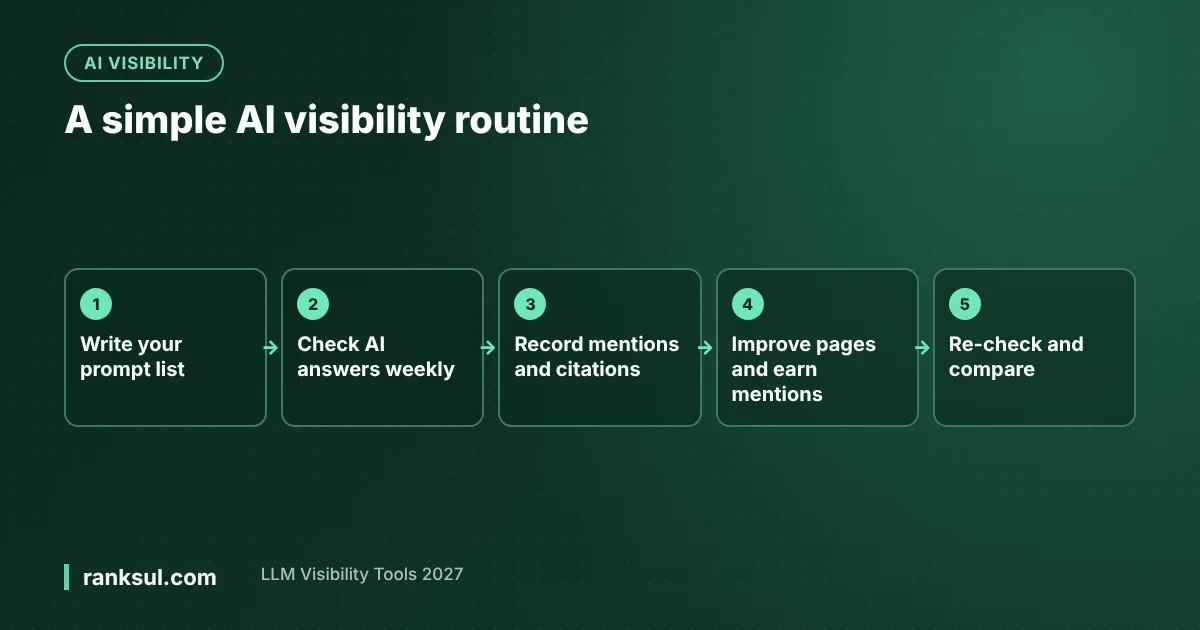
- List 30 to 50 prompts your buyers ask, by topic
- Track mentions and citations monthly with an LLM visibility tool
- Check impressions and clicks for the same topics in Google Search Console
- Improve the pages that are close to being cited: clearer answers, better data, structured data
- Earn mentions on publications in your niche through PR and editorial links
- Request a free SEO audit if you want a second opinion
The metrics LLM visibility tools report
Mentions
How often your brand is named in answers to your tracked prompts.
Citations
How often a page on your site is linked as a source. Citations bring traffic; mentions build awareness.
Share of voice
Your mentions compared with competitors across the same prompts. The most useful single number for tracking progress.
Sentiment and framing
Whether answers describe you positively, neutrally or with caveats, and which attributes they associate with you (price, quality, specialism).
Source domains
Which websites the AI cites for your topic. This is your outreach list: the publications to earn mentions on.
How to choose an LLM visibility tool
Roundups name tools such as Profound, Peec AI, Otterly.AI, AthenaHQ, Ahrefs Brand Radar and the AI tracking features in Semrush and SE Ranking. Rather than trusting any ranking, check these points against your needs.
- Which engines it tracks: ChatGPT, Perplexity, Gemini, Google AI Overviews and AI Mode, Copilot
- How many prompts and how often they are run
- Whether it tracks competitors and share of voice
- Whether it shows the exact sources cited for each answer
- Countries and languages supported
- Reporting: exports, dashboards, white-label for agencies
- Price per prompt tracked, not only the monthly fee
A free way to track AI visibility
Before paying for a tool, set up a manual baseline. List 30 prompts across three groups: category questions ("best link building services for SaaS"), comparison questions ("Ranksul vs X") and problem questions ("how much do backlinks cost"). Run each monthly in each engine, in a clean session, and record: mentioned (yes/no), cited (URL), competitors named, sources cited. Answers vary between runs, so look at trends over months, not single answers.
In your analytics, create a segment for referral traffic from chatgpt.com, perplexity.ai, gemini.google.com and copilot.microsoft.com. Google AI Overviews clicks appear as ordinary Google organic traffic.
Turning the data into actions
- Sources cited for your topic but not mentioning you: outreach and PR targets
- Prompts where competitors appear and you do not: content gaps on your site
- Wrong facts about your brand: fix them on your site, profiles and directories
- Pages of yours that get cited: update and link to them internally
How LLMs see your brand
A language model does not look your brand up in a database. It learns which brands belong to which topics from the text it was trained on, and assistants with web search add whatever pages they retrieve for the question. If many independent sources describe you as "a link building marketplace with live samples", that is how the model will describe you, and that is the topic it will associate you with.
Three things shape brand presence in LLMs: how often you are mentioned next to a topic, how consistent those descriptions are, and how trusted the sources are. A brand mentioned on a few respected publications, review sites and forums in the same words is easier for a model to place than a brand with a large but inconsistent footprint.
- Ask each assistant "What is [brand]?" and "What is [brand] known for?" to see the description it has learned
- Ask "Who are the best [category] providers?" to see whether it associates you with your topic at all
- Note the attributes it uses (cheap, enterprise, UK-based, fast): these come from your mentions, not your homepage
- Check which sources it cites for those claims: they are the pages shaping your brand in AI
How to audit brand visibility on LLMs
An LLM visibility audit gives you a baseline before you change anything. It takes an afternoon and can be repeated each month, by hand or with a tool.
- Write 30 to 50 prompts in three groups: category ("best X for Y"), comparison ("[brand] vs [competitor]") and problem questions ("how much does X cost")
- Run each prompt in ChatGPT, Perplexity, Gemini, Copilot and Google (AI Overviews and AI Mode), in a logged-out or clean session
- Record for each answer: mentioned (yes or no), cited with a link (URL), position in the answer, competitors named and sources cited
- Score share of voice: your mentions divided by all brand mentions across the prompt set
- Check accuracy: wrong prices, old services or a mistaken location are fixes in their own right
- List the domains cited for your topic that never mention you: this is your outreach and PR list
- Repeat monthly with the same prompts so the results are comparable
LLM citation tracking: tools and analytics
LLMO tools (LLM optimization tools) automate the audit above: they run your prompts on a schedule, store every answer and report mentions, citations, share of voice and the sources each engine relies on. A good LLM citations tracker shows the exact URL cited for each prompt, so you can see which of your pages earn links from AI answers and which competitor pages win instead.
Pair a tracker with LLM visibility analytics from your own data. In Google Analytics 4, build an exploration or segment for sessions whose source is chatgpt.com, perplexity.ai, gemini.google.com, copilot.microsoft.com or claude.ai. That shows the visits ChatGPT citations for your brand actually send, which landing pages they reach and whether they convert. Clicks from Google AI Overviews are counted as ordinary Google organic traffic, so watch them in Search Console.
How to get mentioned in LLMs
Getting cited by AI answers is mostly earned, not optimised. Studies of AI citations, such as a 2025 analysis by Profound, found that Wikipedia was the most-cited source in ChatGPT, while Reddit led in Perplexity and Google AI Overviews, with YouTube, review platforms and major news sites close behind. The top-cited sources in LLMs are places where many people describe and compare brands.
Expert quotes help too. The research paper that named generative engine optimization found that adding quotations from credible sources was one of the most effective changes for visibility in AI answers, alongside statistics and citations. Being the expert quoted in other people's articles works the same way from the outside: each quote is a fresh, attributed mention of your brand next to your topic.
- Earn coverage on the publications the engines already cite for your topic, found in your audit; digital PR and news site placements do this
- Offer expert commentary and data to journalists: earned media gives LLMs attributed, trusted mentions
- Keep profiles consistent on review sites, directories and Wikipedia-style references that describe your category
- Take part honestly in community discussions (Reddit, forums, YouTube) where buyers compare options; never astroturf
- Publish original data and clear definitions on your own site, so there is something worth citing
When to invest in LLM optimization
Invest once your basics are in place: indexable pages, clear service pages and some authority from other sites. LLM optimization builds on SEO, so a site that does not rank or is rarely mentioned has nothing for AI answers to draw on yet. The best time is when buyers in your market already use AI assistants to shortlist suppliers, which your audit and AI referral traffic will show.
You do not need separate LLM SEO services for most of the work. The same activities, content that answers questions clearly and mentions on trusted publications, improve both Google rankings and AI visibility. Where an LLM SEO consultant adds value is in setting up the prompt tracking, reading the citation data and turning it into a list of publications and pages to work on. Ranksul's publisher marketplace lets you act on that list directly.
Prompt list template
A starting set for a service business. Replace the brackets and keep the same list each month so results are comparable.
- "What are the best [service] companies for [audience]?"
- "How much does [service] cost?"
- "[Your brand] vs [competitor]"
- "Is [your brand] good?" and "[your brand] reviews"
- "How do I choose a [service] provider?"
- "[Service] in [country or city]"
- "Alternatives to [competitor]"
What to do when AI answers get your brand wrong
Wrong prices, old addresses or a mistaken description usually come from outdated pages, directories or articles. Find the likely source (ask the assistant where the information comes from, or check the cited sources), correct it on your own site first, then update profiles and directories, and ask publishers to update old articles. Clear, consistent facts on an About page and an llms.txt file help, but outside sources carry the most weight.
Frequently asked questions
Is AI SEO different from normal SEO?
Mostly not. The same foundations apply: indexable pages, helpful content, clear structure and authority from other sites. AI SEO adds tracking of AI answers and a stronger focus on direct, quotable answers.
Can I pay to appear in AI Overviews?
No. Ads can appear near AI answers, but citations in AI Overviews come from Google's organic index.
How long does it take to see results?
Content and link improvements usually show in classic rankings first, often within weeks to a few months, and AI citations follow as those pages gain visibility.
What is LLM visibility?
LLM visibility is how often and how accurately large language models and AI assistants, such as ChatGPT, Gemini, Perplexity, Copilot and Google AI Overviews, mention your brand and cite your website when people ask questions about your topic.
What are LLMO tools?
LLMO (LLM optimization) tools track your brand in AI answers. They run a set of prompts on a schedule and report mentions, citations, share of voice, sentiment and the sources each AI engine cites.
How can I see ChatGPT citations for my brand?
Ask ChatGPT, with search on, the questions your buyers ask and look at the sources it links. To track this over time, use an LLM citation tracker, and check referral traffic from chatgpt.com in Google Analytics.
Do LLM citations affect brand trust?
Yes. Being named and linked in an AI answer works like a recommendation from a neutral source, and buyers increasingly shortlist suppliers from those answers. Wrong or missing information has the opposite effect, which is why accuracy is part of every audit.
Are LLM visibility tools accurate?
They are samples. AI answers vary between runs, users and locations, so treat the numbers as trends across many prompts rather than exact positions.
Do I need an LLM visibility tool?
Not to start. A manual prompt list tracked monthly gives you a baseline; a tool becomes worth it when you track many prompts, markets or competitors.
Want Ranksul (ranksul.com) to execute this strategy for your domain?
Book a complimentary strategy call. We will audit your current topical authority, editorial backlinks, and content clusters.