Backlink Marketplace vs Agency vs Manual Outreach: Which Is Right for You?
A marketplace lets you pick every site yourself; an agency plans and runs the campaign for you. Here is how they compare on control, cost, speed and risk, and when to use both.

Ranksul Team
SEO & Link Building Team
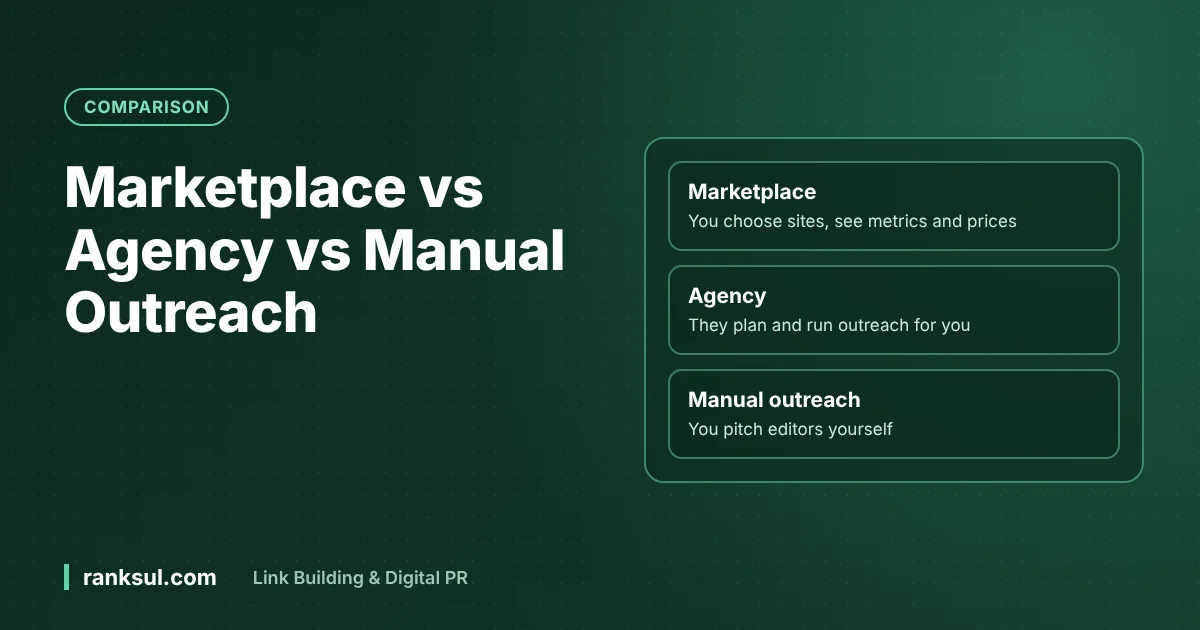
Two ways to buy link building
A link building marketplace is a catalogue of publishers that accept guest posts or sponsored articles. You filter by niche, country, authority and price, add sites to a cart and order placements. A traditional agency works the other way round: you describe your goals, and the agency plans the campaign, finds sites, negotiates and reports back.
Ranksul offers both: a publisher marketplace with 11,000+ websites and managed editorial link building. This guide explains when each makes sense.
Backlink marketplace vs manual link building: the short answer
A backlink marketplace is faster and more predictable: you see the site and price, order, and the link is usually live within days. Manual link building costs no placement fees and earns links that cannot be bought, but each link takes hours of research, pitching and follow-up, and many pitches get no reply. Most effective campaigns use both.
- Cost per link: marketplace, a visible price per placement; manual, mostly staff time
- Time per link: marketplace, minutes to order; manual, often several hours each
- Predictability: marketplace, high; manual, low
- Control over which sites: marketplace, full; manual, only the sites that say yes
- Links you can get: marketplace, sites that accept articles; manual, also resources, partners and press
- Risk: both are low when sites are relevant and paid links are disclosed
Marketplace: control and transparency
The biggest advantage of a marketplace is that you see everything before you pay: the publisher, its DA and DR, its organic traffic, whether links are Do-Follow or No-Follow, the turnaround and often a live sample article. Nothing is hidden behind a monthly retainer.
Marketplaces are fast for teams that already know which sites they want, and they suit agencies that resell links to their own clients through a white-label or reseller program.
- Choose every site yourself
- See metrics, link type and samples before ordering
- Pay per placement, with no retainer
- Order in any niche or country: technology, business and finance, UK and more
Agency: strategy and outreach
An agency earns its fee with judgement. A good one audits your backlink profile, compares it with competitors, decides which pages need links, plans anchor text and pitches publications that do not sell placements openly. That last part, manual outreach, is how you earn links from sites your competitors cannot simply buy.
The trade-off is less direct control and a longer setup, and the quality depends entirely on the agency's standards, so ask to see example placements before you sign.
Manual link building: doing outreach yourself
The third option is to build links yourself: find relevant sites, pitch them an article, a resource or a story, and earn a link without buying a placement. Manual outreach produces the most natural links and costs no placement fees, but it is slow. Each link takes research, personalised emails, follow-ups, writing and checking, and many pitches get no reply.
Manual outreach works best for links that cannot be bought: resource pages, industry associations, partners, suppliers, local organisations and journalists covering your news. Most businesses combine some of it with marketplace placements or an agency.
Side by side: marketplace vs agency vs manual outreach
Backlink marketplace
You choose every site and pay per placement. On Ranksul, the median placement costs $80 including the article, with most placements live within 3 days of approval.
- Control: full, you pick each site
- Speed: days
- Cost: per placement, visible before you order
- Your time: low to medium (choosing sites, briefing anchors)
- Risk: depends on the sites you pick
Link building agency (managed)
The agency plans the campaign, chooses sites, runs outreach and reports. Ranksul's managed link building starts at $280 per placement on DR 50+ sites; many agencies charge a monthly retainer instead.
- Control: you approve, they choose
- Speed: weeks to set up, then monthly
- Cost: higher per link, includes strategy and reporting
- Your time: low
- Risk: depends on the agency's standards
Manual outreach (in-house)
Your team finds and pitches sites directly. No placement fees, but the cost is people's time, and results are less predictable.
- Control: full
- Speed: slow, links arrive unpredictably
- Cost: staff time and tools
- Your time: high
- Risk: low when done honestly
Which should you choose?
- Choose a marketplace if you know SEO, want control and need links quickly at a known price
- Choose an agency if you lack time or experience, or need strategy, anchor planning and reporting
- Choose manual outreach for links that cannot be bought: partners, associations, resources and press
- Combine them if you are serious about competitive keywords: most growing sites do
How to judge quality either way
Metrics such as Domain Rating from Ahrefs and Domain Authority from Moz are useful filters but easy to inflate. Check that a site ranks for real keywords and that its traffic is steady, look at what else it links to, and read a few recent articles. Our guide to choosing the right DA and DR metrics walks through the checks.
Follow Google's spam policies and avoid private blog networks and link farms, whichever route you choose.
Cost: what you actually pay for
Marketplace prices are per placement and visible up front. Agency pricing usually bundles placements with strategy, outreach and reporting. Compare the cost per quality placement, not the headline monthly fee. Ranksul's marketplace shows prices once you sign up for free, and you pay only after we confirm availability; see pricing for managed plans.
For real numbers, our Link Building Price Index breaks down what 11,000+ publishers charge by authority, traffic, country and niche, with a budget calculator. To compare an agency retainer, divide the monthly fee by the number of live links it delivers.
When to use both
Most growing brands end up using both. They buy known placements from a marketplace when speed matters, and they rely on an agency for strategy, competitor gaps and outreach to sites that need a relationship. If you are unsure where to start, talk to us and we will suggest a mix for your budget.
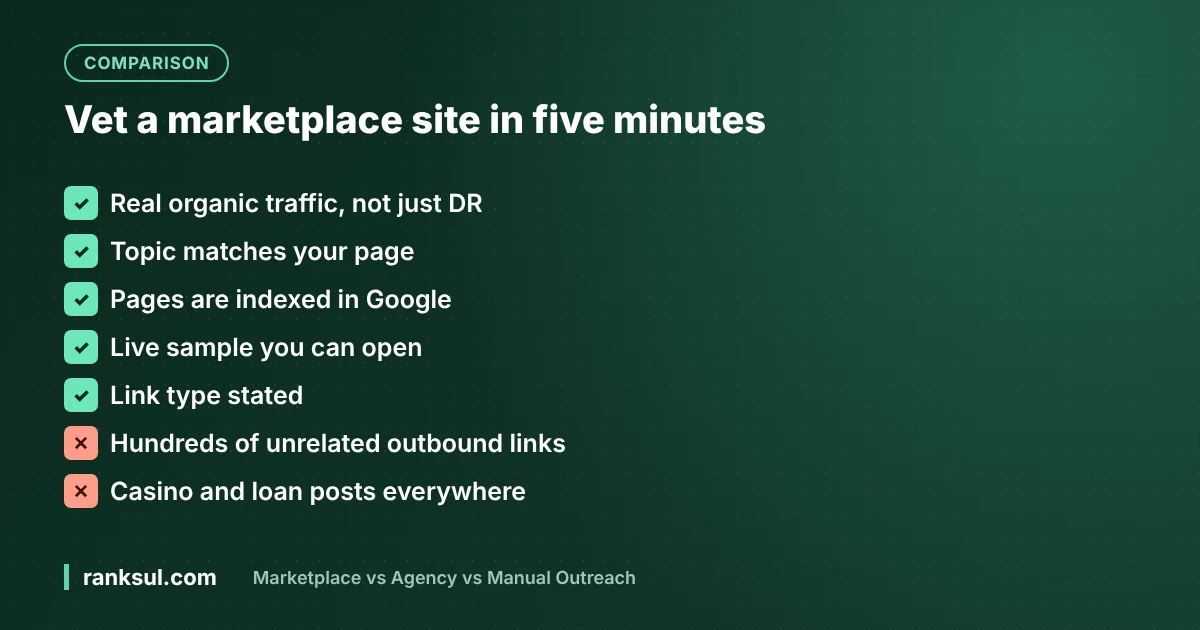
Red flags in a backlink marketplace
- Prices far below what similar sites charge elsewhere
- No traffic figures, or traffic that does not match the site
- No sample articles and no way to see the site before ordering
- The same sites listed for every niche
- No information on link type (do-follow or no-follow)
- No policy for removed links
How to vet a site in a marketplace in five minutes
- Open the site: does it look like a real publication with recent articles?
- Check organic traffic and its trend in an SEO tool
- Read the live sample: is it written for readers, and is the link in context?
- Look at recent posts: do they all link out to commercial sites?
- Confirm the link type and whether articles are indexed
- Compare the price with similar sites in the marketplace
How backlink marketplaces work
Publishers list their sites with metrics, prices, link types and turnaround. Buyers filter by niche, country, authority and price, place an order with a target URL and anchor, and either supply an article or have one written. The publisher reviews and publishes it, and the buyer receives the live URL. Good marketplaces vet publishers, show samples, and handle disputes and replacements; on Ranksul, nothing is charged until availability is confirmed.
Which option fits which business
- Startup with a small budget and SEO skills: marketplace placements plus founder-led outreach
- Local business without time: a managed service or agency with local experience
- SaaS company with a content team: marketplace for target pages, in-house outreach for data assets
- Ecommerce brand: marketplace or agency for category links, digital PR for seasonal stories
- SEO agency serving clients: marketplace or white-label provider for fulfilment
Google's rules on buying links
Google's spam policies treat buying links that pass ranking credit as a link scheme. Paid placements are acceptable when they are disclosed, with the link marked rel="sponsored" (or nofollow) as the publisher requires. That is why a good marketplace states each site's link type and policy up front, rather than promising hidden followed links.
The four types of link building marketplace
Not every marketplace carries the same risk.
- Bulk and PBN platforms: cheap, automated links on sites with no real readers; the highest risk
- Open catalogs: long lists of sites with prices and some metrics; quality varies, so you vet every site yourself
- Managed editorial platforms: vetted publishers, written content and someone accountable for each placement
- Direct publisher deals: you agree terms with the site itself; transparent but slow to scale
What manual link building really costs: a worked example
Reply rates for cold outreach are often in single figures. Suppose one person sends 100 personalised pitches a month and 5 turn into links. If finding contacts, writing pitches, following up and writing the articles takes 40 hours, each link costs about 8 hours of work. Multiply by that person's hourly cost to compare with a marketplace price.
Your numbers will differ: a strong brand, a genuinely useful resource or an existing relationship can raise the success rate a lot. Track pitches, replies and live links for a month before deciding which route is cheaper for you.
Guest posts, sponsored posts and link types in a marketplace
Not every marketplace placement is the same. Some publishers publish your article as a regular guest post; others label it as sponsored content and mark the link rel="sponsored" or no-follow, as Google asks for paid links. Neither is wrong, but you should know which you are buying. See sponsored posts vs guest posts for the difference, and our link building safety standards for how sites are vetted.
Frequently asked questions
Is buying links from a marketplace safe?
It is as safe as the sites you choose. Pick relevant publications with real traffic and editorial standards, and avoid networks built only to sell links.
Can I see sample articles before ordering?
On Ranksul, many publishers show a live sample article, and you can request one for the rest.
Is a backlink marketplace better than manual link building?
Neither is better in every case. A marketplace is faster and more predictable; manual outreach earns links that cannot be bought and costs no placement fees, but takes much more time. Most effective campaigns use both.
How much does a link building agency cost compared with a marketplace?
Per link, an agency costs more because it includes strategy, outreach and reporting. On Ranksul, marketplace placements have a median price of $80 and managed placements start at $280 on DR 50+ sites.
Do marketplaces offer a guarantee?
Ranksul placements are covered by a 1-year replacement warranty: if a link is removed, we replace it.
How do I choose between the best link building agencies?
Compare them on the sites they actually use, whether you can approve placements, how they report and what happens if a link is removed. Our list of the best digital PR and link building agencies compares ten options side by side.
Are the metrics listed in a marketplace accurate?
They are only as good as their source and date. Check that DR and traffic come from a named tool, are recent, and match what you see yourself, and treat a high DR with very little traffic as a warning sign.
Can I filter marketplace sites by niche, country and traffic?
On most good marketplaces, yes. Ranksul's marketplace filters by niche, country, DR, traffic and link type, and shows a live sample article where one exists.
How long does manual link building take per link?
Often several hours per live link once you count research, personalised pitches, follow-ups and writing, because many pitches get no reply. A strong resource or an existing relationship can cut that a lot.
Is it cheaper to build links manually or buy them?
Manual outreach has no placement fees but costs staff time; a marketplace costs a visible price per link but saves the time. Work out your cost per live link for both before deciding.
Want Ranksul (ranksul.com) to execute this strategy for your domain?
Book a complimentary strategy call. We will audit your current topical authority, editorial backlinks, and content clusters.