Niche Edits vs Guest Posts: Which Link Type Is Better for SEO?
Niche edits add your link to an article that is already published; guest posts are new articles written for the site. Here is how they compare on speed, cost, control and risk, and when to use each.

Ranksul Team
SEO & Link Building Team
What is a guest post?
A guest post is a new article written for another website and published under its brand, with a link back to your site inside the text. You or the publisher's writers create the article to fit the site's style and readers.
Because the article is new, you choose the topic, the angle and where the link sits. The page starts with no traffic or links of its own and builds them over time. See our guest posting services for how we handle them.
What is a niche edit?
A niche edit (also called a link insertion or curated link) adds your link to an article that is already published and indexed by Google. The editor adds a sentence or adjusts an existing one so the link fits naturally.
The article usually already has some traffic, internal links and age, so Google may find and count the new link quickly. You control less of the context, because the article already exists. See our niche edits service for details.
Niche edits vs guest posts at a glance
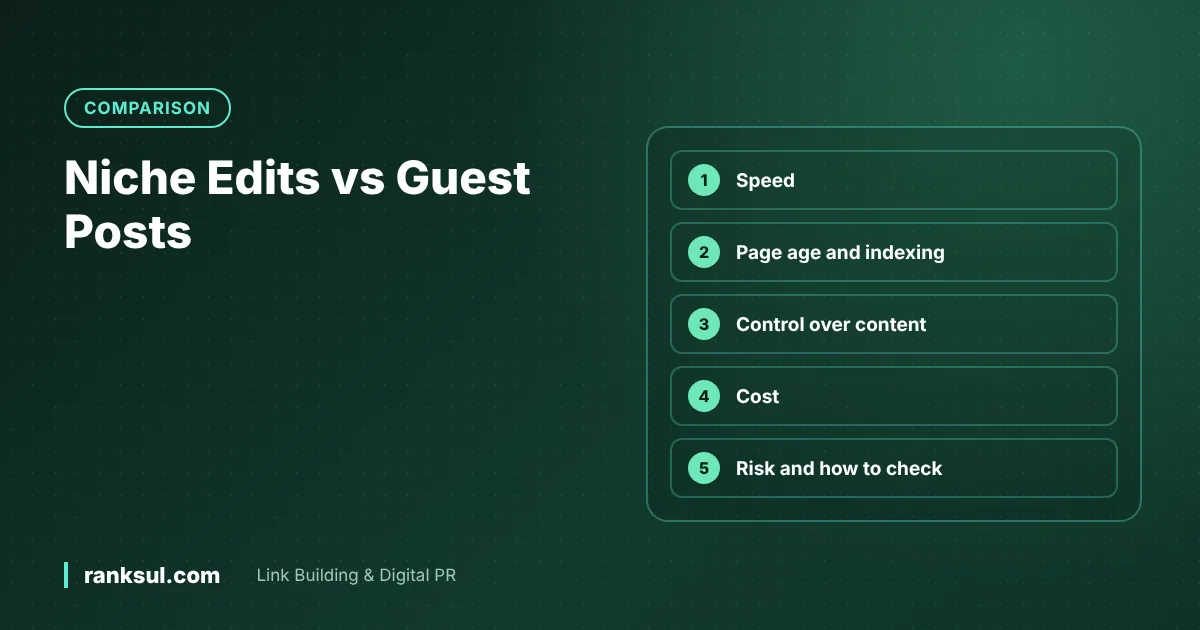
The two link types solve different problems. This is how they compare on the points that matter most:
- Speed: niche edits often go live within days; guest posts need writing and editing first
- Page age: niche edits sit on established pages; guest posts start on a brand-new page
- Control: guest posts let you choose topic, angle and link placement; niche edits fit an existing text
- Content cost: guest posts include writing; niche edits only need a sentence or two
- Indexing: niche edit pages are already indexed; new guest posts need to be crawled first
- Fit: guest posts can be written to match your page exactly; niche edits depend on finding a relevant existing article
When a guest post is the better choice
Choose a guest post when the context matters most: launching a new topic, linking to a product or service page that needs a full explanation, or building a byline and expertise on publications your customers read.
Guest posts also work better when no existing article on the site is a close match. Forcing a link into an unrelated article helps nobody.
When a niche edit is the better choice
Choose a niche edit when a site has a published article that already fits your page closely, especially one with its own traffic and links. It is also the faster option when you need several links in a short time.
Niche edits suit supporting pages such as guides and resources, where one relevant mention in an established article is exactly what you need.
Cost: what each typically costs
Prices vary far more by site than by link type. In the Ranksul marketplace the typical placement costs $80, and half of all publishers charge between $43 and $215, with stronger and higher-traffic sites costing more. Our Link Building Price Index breaks prices down by DR, niche and country.
A guest post price usually includes the article. With a niche edit you pay for the placement only, but strong pages with existing traffic can cost as much as a new article.
Risks and how to avoid them
The risks are the same for both: links on sites that exist only to sell them, pages with no readers, and patterns that look manipulative. Google's spam policies cover paid links whatever form they take, so paid links should carry rel="sponsored".
Watch for these warning signs before you buy either kind:
- The site publishes on every topic and sells links openly on every page
- Recent articles carry long lists of unrelated outbound links (casino, loans, pills)
- Organic traffic is tiny or falling while DR is high
- For niche edits: the article is years old, has no traffic, or the new sentence reads like an advert
- For guest posts: the article will be marked "sponsored" in a section that is not indexed
Using both in one campaign
Most campaigns work best with a mix. Use guest posts for your most important pages, where you want full control over the article and how your page is introduced, and niche edits to add supporting links quickly from established articles on closely related topics.
Spread placements over several weeks, link to different pages and vary the anchor text. A steady mix of new articles and existing ones looks natural and gives you two ways to reach the sites that matter in your field.
How to check a placement before you buy
Look at the page, not just the domain. Search site:domain.com to confirm the site is indexed, check organic traffic in Ahrefs or Semrush, and read two or three recent articles. Our 15-point guest post site checklist works for niche edit targets too.
In the Ranksul marketplace every publisher shows its DR, DA, organic traffic, link type and price, and signed-in clients can open sample articles before ordering.
Frequently asked questions
Are niche edits safe?
They are as safe as the site they are on. A relevant link added to a genuine article on a site with real readers is fine; links forced into unrelated articles on link-selling sites are not.
Do niche edits work faster than guest posts?
Usually. The page is already indexed and may have traffic, so Google can find the link quickly. A new guest post has to be crawled and indexed first.
Should I use niche edits or guest posts for a new website?
Start with a few guest posts on relevant sites to build context and a varied link profile, then add niche edits where established articles fit your pages closely.
What is the difference between a niche edit and a sponsored post?
A niche edit adds a link to an existing article. A sponsored post is a new article published as paid content, usually labelled as sponsored by the publisher.
Want Ranksul (ranksul.com) to execute this strategy for your domain?
Book a complimentary strategy call. We will audit your current topical authority, editorial backlinks, and content clusters.