B2B SEO: A Complete Strategy for Pipeline, Not Just Traffic (2027)
B2B buyers research for weeks before they talk to sales. Here is how leading B2B companies use SEO to appear at every stage of that research and turn it into pipeline.

Ranksul Team
SEO & Link Building Team
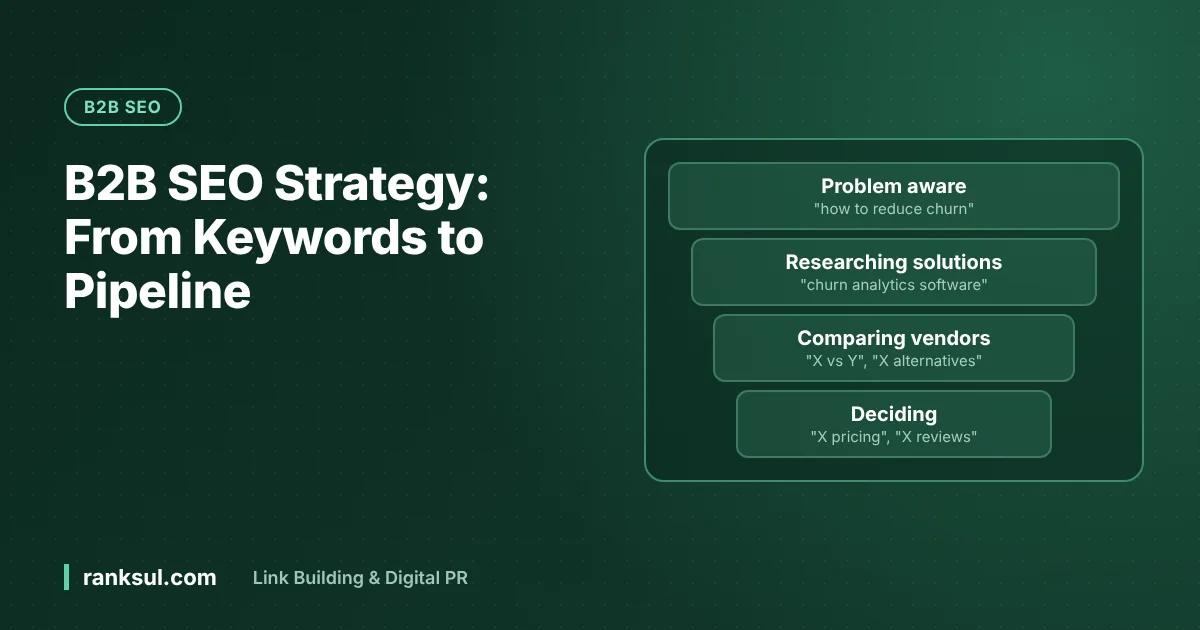
How B2B buyers search
B2B purchases involve several people and long research cycles. Buyers search for their problem, then for categories of solution, then for specific vendors, comparisons and reviews. Each stage is an opportunity to be found, and the companies that win in search show up at all of them with useful answers.
Our B2B SEO service starts by mapping these stages for your product and finding the searches your competitors already rank for.
Map keywords to buying stages
Group your keywords by intent rather than volume. Low-volume, high-intent searches such as "[product category] for [industry]" or "[competitor] alternative" often bring more pipeline than broad terms with thousands of searches. Tools like Ahrefs and Semrush show competitor rankings and keyword difficulty; Google Search Console shows the queries already bringing you impressions.
- Problem: "how to reduce churn in SaaS", "why is our pipeline slow"
- Solution: "customer success software", "revenue intelligence tools"
- Comparison: "[tool A] vs [tool B]", "[competitor] alternatives"
- Vendor: "[your brand] pricing", "[your brand] integrations", "[your brand] reviews"
Build the pages that convert
Leading B2B companies invest heavily in bottom-of-funnel pages: honest comparison pages, alternatives pages, integration pages, use-case pages by industry and clear pricing. These pages answer the questions buyers ask just before they book a demo.
Write them with real detail: who each option suits, where you are stronger and where you are not. Buyers trust balanced comparisons, and search engines reward pages that fully answer the query. For SaaS companies, our SaaS SEO service builds these page types systematically.
Expert content that earns trust
B2B content has to convince experts. Use the knowledge inside your company: interviews with engineers and customer success teams, original data from your product, and detailed how-to guides. Google's guidance on helpful, people-first content emphasises first-hand expertise, which is exactly what generic content lacks.
Organise it into topic clusters so each guide supports a core page, as explained in our article on topical authority architecture. Our content strategy and SEO content writing teams can plan and write the cluster with your experts.
Authority from the publications your buyers read
Links and mentions on respected industry and business publications strengthen your rankings and reassure buyers who look you up. Focus on sites your buyers actually read: business, finance and technology media in your markets.
Ranksul's marketplace lets you browse technology and business and finance publishers with their metrics and samples, and our guest posting services place expert articles on them.
Measure pipeline, not just traffic
Connect organic sessions to form fills, demo requests and opportunities in your CRM. Report on organic pipeline and revenue by page group each quarter. Traffic that never converts is a signal to rethink intent, not a win.
Want to know where your B2B site stands? Request a free SEO audit and we will review your keywords, pages and links.
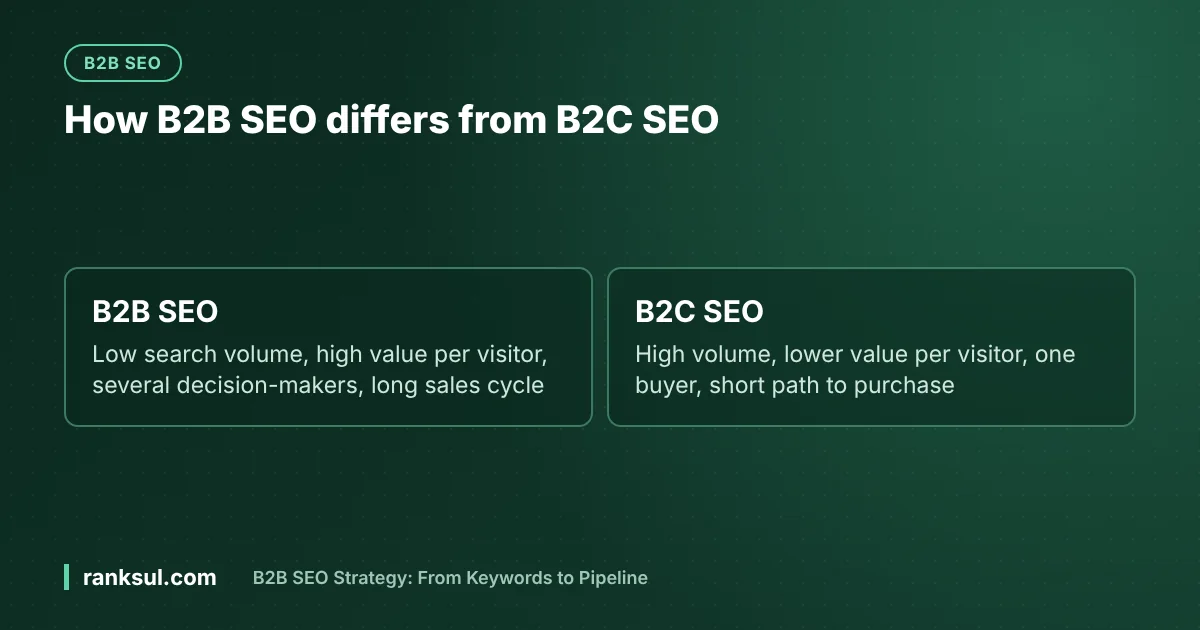
How B2B SEO differs from B2C SEO
Search volumes are smaller, buying cycles are longer, and several people influence each decision. Gartner's research on B2B buying has found that buyers spend only a small share of their buying time meeting suppliers; most of it goes on independent research and internal discussion. A single keyword with 50 searches a month can be worth more than a consumer keyword with 50,000 if the right buyers search it.
Content for each member of the buying committee
- The user: how-to guides, feature pages, integrations, templates
- The manager: use cases, ROI explanations, case studies, comparisons
- Finance: pricing pages, cost breakdowns, total cost of ownership
- IT and security: security, compliance, data handling and integration documentation
- The executive sponsor: industry trends, original research, thought leadership
Bottom-funnel pages to build first
These pages target people close to a decision. They get less traffic but convert far better, which is why most B2B SEO programmes should start here rather than with top-of-funnel blogging.
- "[Your category] pricing" and an honest pricing page
- "[Competitor] alternatives" and "[You] vs [Competitor]" comparisons
- Use-case pages: "[category] for [industry or role]"
- Integration pages: "[your product] + [tool they use]"
- Templates and calculators linked to your product
B2B link building that buyers notice
B2B buyers trust the publications, associations and analysts in their industry. Links and mentions there build rankings and credibility at the same time: guest articles in trade media, original research that journalists cite, partner and integration directories, podcast appearances, and listings on review sites such as G2, Capterra or Clutch. See our SEO for SaaS service.
B2B SEO and AI search
Buyers increasingly ask AI assistants for shortlists ("best CRM for small law firms"). Those answers draw on comparison pages, review sites and industry coverage. Make sure your positioning is clear and consistent across your site and profiles, and that you appear on the sources AI tools cite for your category. Our GEO guide explains how.
Measuring B2B SEO properly
Connect analytics to your CRM so organic leads are tagged by landing page. Report on organic leads, sales-qualified leads, pipeline and revenue influenced, alongside rankings for bottom-funnel terms. Ask new leads how they found you: self-reported attribution often reveals AI tools, podcasts and articles that analytics misses.
Example: B2B keyword map for a payroll software company
- Awareness: "payroll compliance checklist", "how to run payroll for contractors"
- Consideration: "best payroll software for small business", "payroll software comparison"
- Decision: "[brand] pricing", "[competitor] alternatives", "[brand] vs [competitor]"
- Use cases: "payroll software for restaurants", "payroll for remote teams"
- Integrations: "payroll software that integrates with [accounting tool]"
Common B2B SEO mistakes
- Blogging about broad trends while pricing and comparison pages are missing
- Gating every useful resource so search engines and buyers cannot read it
- Jargon-heavy pages that do not match how buyers search
- Measuring traffic instead of qualified leads
- No links from industry publications and associations
B2B keyword research: finding low-volume, high-value terms
B2B tools often show "0–10" searches for valuable terms, because volumes are small and spread across many variants. Better sources: sales call notes and recorded questions, support tickets, competitor comparison pages, review sites in your category, Reddit and industry forums, and Search Console queries your site already appears for. A term your sales team hears weekly is worth a page even if a tool says nobody searches it.
Technical SEO for B2B sites
- Product and documentation pages are indexable, not hidden behind logins
- Gated resources have an indexable landing page that explains the content
- Single-page app frameworks render content for search engines
- Separate marketing and docs subdomains are linked to each other
- Pricing and feature pages are crawlable HTML, not images or PDFs
B2B SEO tools
Search Console and analytics connected to your CRM come first, because they tie organic visits to leads. Add an SEO suite (Ahrefs, Semrush or similar) for keyword and competitor research, a rank tracker for your bottom-funnel terms, and an AI visibility tracker for the prompts buyers use to build shortlists.
B2B SEO best practices
A short checklist to keep a B2B SEO program on track.
- Choose B2B SEO keywords by buyer intent, not volume: a term with 50 searches from decision makers beats one with 5,000 from students
- Build bottom-funnel pages (comparisons, pricing, integrations, use cases) before top-of-funnel articles
- Give every page one job and one call to action that fits its stage in the funnel
- Use real expertise: named authors, original data and customer examples
- Earn links from the industry and business publications your buyers read
- Report on leads and pipeline from organic search, not only traffic
B2B search engine marketing: SEO and paid search together
B2B search engine marketing works best when SEO and paid search share data. Paid campaigns show quickly which keywords bring qualified leads; SEO then targets those terms for the long run at a lower cost per lead.
The B2B SEO tactics that last are the ones that compound: pages that keep ranking, links that keep passing authority and content that keeps being cited. Our B2B SEO services and, for software companies, SaaS SEO and SaaS link building are built around that.
Why SEO matters for B2B companies
B2B buyers do most of their research before they speak to sales: they search for problems, compare vendors and read reviews. SEO puts you in that research. Unlike paid search, the pages keep working after you stop paying, so the cost per lead falls over time.
Search also supports the rest of your marketing. Account-based campaigns, paid ads and sales outreach all work better when the prospect later searches for you and finds clear, useful pages, and AI assistants build vendor shortlists from the same pages.
How to create a B2B SEO strategy in 7 steps
The sections above cover each part in depth. In order, the work looks like this.
- Set goals in pipeline terms: demos, qualified leads or revenue from organic search
- Understand the product and the ideal customer, including every member of the buying committee
- Research how those buyers search, from problem to comparison to vendor checks
- Map keywords to buying stages and choose the pages each one needs
- Build bottom-funnel pages first, then the expert content that earns trust and links
- Fix the technical foundation and make every page easy to convert from
- Measure leads and pipeline by page, then double down on what works
B2B SEO KPIs to track
- Organic leads and demo requests, by landing page
- Pipeline and revenue influenced by organic search
- Rankings and impressions for bottom-funnel keywords
- Conversion rate of organic visitors
- Referring domains from industry and business publications
- Mentions and citations in AI answers for your category
Frequently asked questions
How long does B2B SEO take to produce leads?
Bottom-of-funnel pages can start bringing leads within a few months if the site has some authority. Broader topic clusters usually take six to twelve months to reach full effect.
Should B2B companies blog?
Yes, but with purpose: every article should answer a question your buyers ask and link to a page that converts.
Do B2B sites need backlinks?
In competitive categories, yes. Relevant links from industry publications are often what separates two sites with similar content. See editorial link building.
What is a good B2B SEO conversion rate?
It varies by offer and industry. Bottom-funnel pages (demos, pricing, comparisons) convert many times better than blog posts, which is why page type matters more than an average rate.
How much should B2B companies spend on SEO?
Enough to produce bottom-funnel pages steadily and build authority in your industry. Judge the budget against the value of a customer, which in B2B is often high enough to justify a long-term programme.
Is B2B SEO worth it for a SaaS startup?
Usually, yes, if you start with the pages closest to a sign-up (comparisons, alternatives, use cases and integrations) rather than broad blog posts. Those pages can bring qualified trials within months, while broad content takes longer to pay back.
Want Ranksul (ranksul.com) to execute this strategy for your domain?
Book a complimentary strategy call. We will audit your current topical authority, editorial backlinks, and content clusters.