Local Citations: The Complete Guide to Directory Listings and NAP for Local SEO
Local citations tell search engines your business is real and where it is. Here is how to build consistent listings, which directories matter, and how to go beyond citations to win the map pack.

Ranksul Team
SEO & Link Building Team
What a local citation is
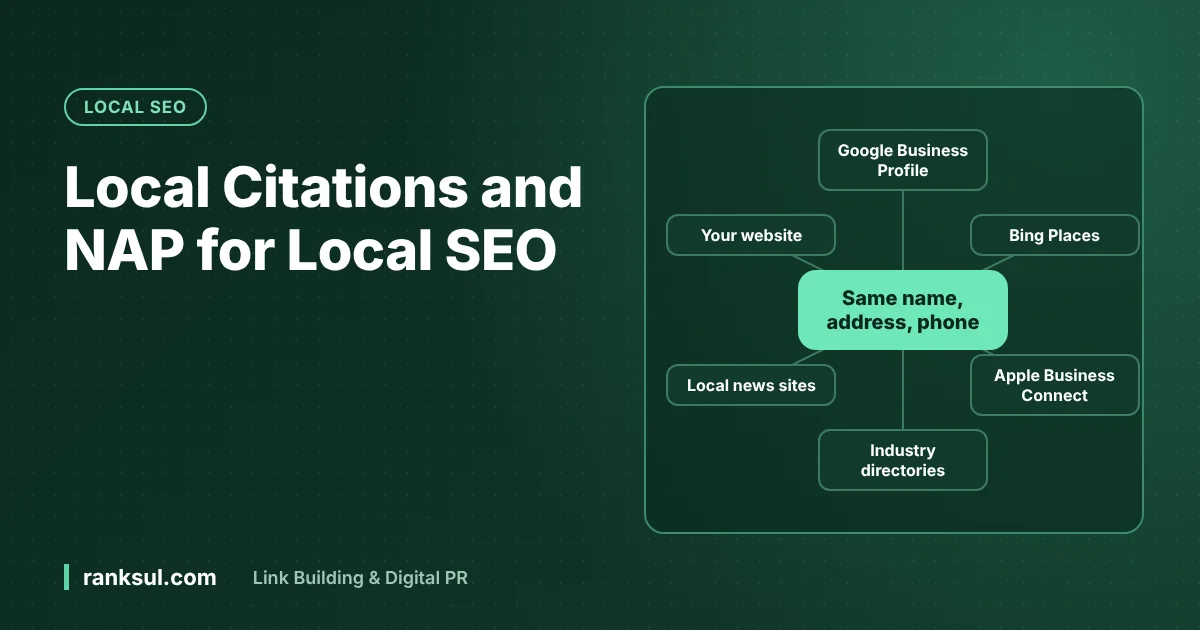
A local citation is a mention of your business on another website, usually including your name, address and phone number, often called NAP. Citations appear on business directories, map apps, industry listings, chambers of commerce and local news sites.
Search engines use citations to confirm that a business exists at a location and to understand what it does. When the same details appear consistently across trusted sources, search engines are more confident showing the business for local searches.
How Google ranks local results
Google explains in its guide to improving your local ranking that local results are based mainly on relevance, distance and prominence. Prominence reflects how well known a business is, using information from across the web such as links, articles, directories and reviews.
Your Google Business Profile is the most important listing. Complete every field, choose accurate categories, add real photos and keep hours up to date. Then claim Bing Places and Apple Business Connect, which feed Bing, Apple Maps and many voice assistants.
The directories that matter
Not every directory is worth a listing. Focus on platforms people actually use and that search engines trust, then on directories specific to your industry and city.
- Google Business Profile, Bing Places and Apple Business Connect
- Major review platforms used in your country, such as Yelp, Trustpilot or TripAdvisor
- Industry directories: legal, medical, home services, hospitality and so on
- Local chambers of commerce and business associations
- Data aggregators that feed many smaller directories in your market
NAP consistency: fix before you build
Inconsistent details confuse search engines and customers. An old address, a call-tracking number on one site and a different business name format on another all weaken trust. Start with an audit: search for your business name, old addresses and phone numbers, and list every place your business appears.
Choose one exact format for your name, address and phone number and update every listing to match. Remove duplicates. Then add new citations in the same format. A free SEO audit from our team includes a check of your main listings.
Going beyond citations: local links and coverage
Citations get you into the game; local authority wins it. Links and mentions from local news sites, community organisations, sponsorships and industry publications are strong prominence signals that most competitors never earn.
Ranksul helps local businesses with local SEO and placements on regional publications. Our marketplace lists news sites by country, including UK publishers and US publishers, and our manual outreach team can pitch local sites that do not sell placements openly.
A 30-day local citation plan
- Week 1: complete and verify Google Business Profile, Bing Places and Apple Business Connect
- Week 2: audit existing listings and correct every NAP inconsistency
- Week 3: add the top general and industry directories for your country
- Week 4: start a review routine and pitch one or two local publications for coverage
- Every month: check Google Search Console and your Business Profile insights for local queries
Structured vs unstructured citations
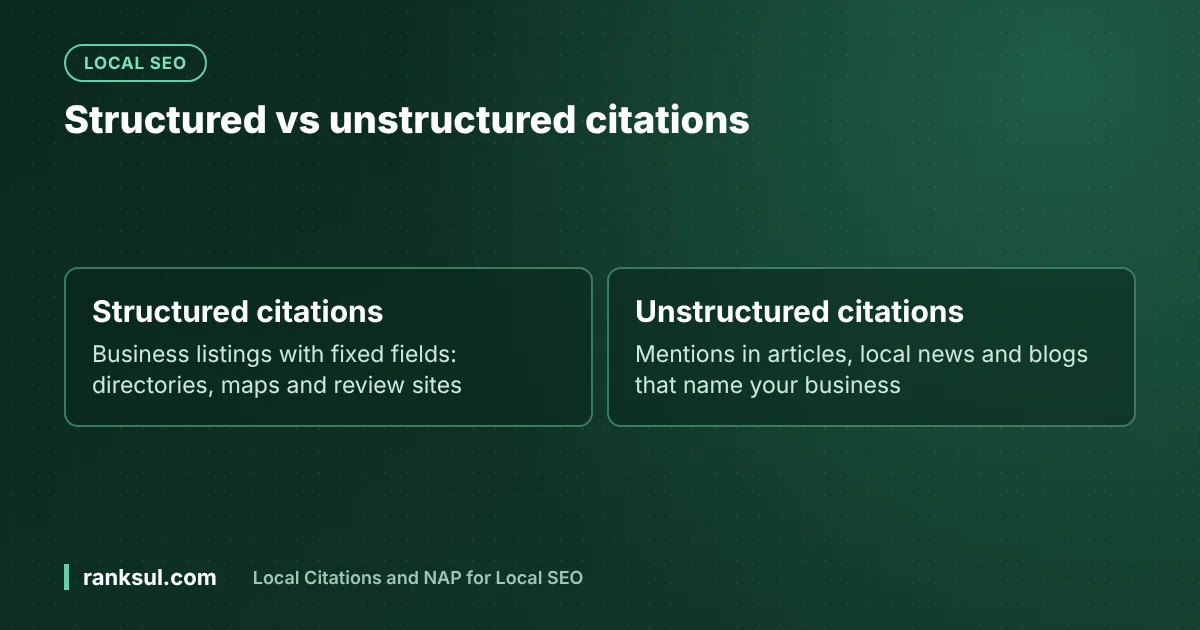
A structured citation is a listing in a directory or platform with set fields: Google Business Profile, Apple Business Connect, Bing Places, Yelp, Facebook, industry directories. An unstructured citation is a mention of your business details in normal content: a local news article, a blog post, an event page, a supplier's list of stockists.
Structured citations establish the facts about your business. Unstructured citations add prominence because someone chose to write about you. A healthy local profile has both.
Citations vs backlinks
A citation does not need a link to count: the mention of your name, address and phone number is the signal. A backlink may or may not include those details. Many of the best local assets are both, for example a local newspaper article that names your business, gives your address and links to your site.
Core citation sources by country
Start with the platforms that feed maps and assistants, then add the leading directories in your country.
Everywhere
Google Business Profile, Apple Business Connect (Apple Maps and Siri), Bing Places (Bing and Copilot), Facebook, and your industry's main directory.
United States
Yelp, Better Business Bureau, Nextdoor, Angi or similar trade directories, chamber of commerce listings, and the data aggregators that supply many smaller sites: Data Axle, Neustar Localeze and Foursquare.
United Kingdom
Yell, Thomson Local, Scoot, Checkatrade or similar trade platforms, FreeIndex and local council or business network directories.
Australia, Canada and the Gulf
Australia: Yellow Pages, True Local and Hotfrog. Canada: YellowPages.ca and Canada411. UAE and Saudi Arabia: local Yellow Pages editions and official business registries and portals.
Industry directories that carry extra weight
- Lawyers: Avvo, Justia, FindLaw, Martindale-Hubbell, local bar association listings
- Healthcare: Healthgrades, Zocdoc, WebMD, national health service directories
- Restaurants and hospitality: TripAdvisor, OpenTable, Zomato or local equivalents
- Home services: Angi, HomeAdvisor, Houzz, Checkatrade, TrustATrader
- B2B and agencies: Clutch, GoodFirms, G2 (software), industry association member lists
How to audit your citations
Search Google for your business name with your old address, old phone numbers and old business names; each result is a listing to fix. Then check the core platforms by hand. Citation tools (BrightLocal, Whitespark, Yext, Semrush Listing Management and others) speed this up by scanning hundreds of sites. Fix the data aggregators first in the US, because many small directories copy from them.
- Exact business name (no extra keywords)
- Same address format everywhere
- One main phone number, local where possible
- Correct website URL (https, with or without www, consistently)
- Primary category and opening hours
- Remove or merge duplicate listings
Optimising each listing
Beyond NAP, fill every field: a clear description of services, categories, service areas, photos, opening hours, booking links and attributes. Listings with photos and reviews are more useful to searchers, and reviews are part of how Google judges prominence. Ask happy customers for reviews regularly and reply to every review.
How to measure citation work
Track Google Business Profile performance (searches, calls, direction requests, website clicks), local pack rankings for your main services in a grid around your location, and referral traffic from directories. Citations rarely move rankings on their own after the core set is done; if they stop helping, shift effort to reviews, local links and local coverage.
Citations for multi-location businesses
Each location needs its own Google Business Profile, its own landing page on your website with that location's address and phone number, and its own citations pointing to that page. Avoid using one central phone number for all locations if you can, keep naming consistent ("Brand – City"), and manage listings in bulk with a listings tool once you pass a handful of locations.
Service-area businesses without a shop front
Plumbers, cleaners and mobile services can hide their address on Google Business Profile and set a service area instead. Use the same approach in other directories that allow it, keep the business name and phone number identical everywhere, and build location-specific service pages on your site for the main areas you serve.
Citations, links and multiple locations
Citations are one part of local SEO; links from local publications and a strong page for each branch are the others. Our local SEO services cover all three, including SEO for multiple locations, and local link building earns links from news and community sites in each area. Law firms can see how this applies to them in link building for lawyers.
Frequently asked questions
How many citations do I need?
There is no magic number. Being listed accurately on the main platforms and the directories for your industry and city matters more than hundreds of low-quality listings.
Do citations need to include a link?
No. Unlinked citations still help confirm your details. Links from relevant local sites add extra value on top.
Can a service-area business without a shop build citations?
Yes. Hide your address on your Business Profile if customers do not visit you, and keep your name and phone number consistent everywhere.
Are local citations still a ranking factor?
They support local rankings mainly by confirming your business details and prominence. After the core platforms and key directories, extra citations add little; reviews and local links matter more.
Should I pay for a citation service?
It can save time for multi-location businesses or when cleaning up many old listings. A single-location business can usually do the core set by hand. If you pay, ask for the list of directories first, check that you will own the logins, and avoid services that promise hundreds of listings.
Do citations help with AI assistants?
Yes. Assistants such as Siri, Copilot and Google's AI features draw on map and directory data, so accurate listings help them describe and recommend your business correctly.
How do I build NAP citations for local SEO?
Start by fixing one exact version of your business name, address and phone number. Complete your Google Business Profile first, then Bing Places and Apple Business Connect, then the main directories and data providers in your country, then directories for your industry and city.
Keep a spreadsheet of every listing with its login, and correct old or duplicate listings before adding new ones.
Want Ranksul (ranksul.com) to execute this strategy for your domain?
Book a complimentary strategy call. We will audit your current topical authority, editorial backlinks, and content clusters.